A simulated gate that keeps cat qubits' special protection
Preprint, not yet peer-reviewed | Simulation
By the authors' account no dedicated coupler for a bias-preserving gate between two Kerr-cat qubits had been proposed and checked at the circuit level before.
Our understanding
Cat qubits store information in a microwave field that is in two states at once. Their charm is that one of the two basic types of error almost never happens. Only the other type remains, and an extra layer of error correction can then focus on that one. But the CX gate, the linking operation that error correction with cat qubits needs, can turn the common error type into the rare one if it is built the naive way. The authors propose a coupling element that avoids this. In computer simulations, their linking operation reached a fidelity of 99.69 % in 50 billionths of a second, without loss of microwave photons. The authors then added a deliberately high photon loss rate of 100 kHz as a stress test. The gate’s fidelity fell to 77.5 %, about as low as for a qubit that sits idle for the same time, but its lopsided error balance stayed about 570 times stronger than with a naive approach. At a lower loss rate of 0.75 kHz, used in earlier work, the gate reached 99.48 %. It is a simulation. Nothing has been built yet. The paper is a preprint.
A few papers like this every Monday, free.
Free. Unsubscribe anytime. Privacy
The details
Key number: Simulated average CX gate fidelity 99.69 % at 50 ns without photon loss, and noise bias about 9922 against about 17 for a naive CX at a deliberately high single-photon loss rate κ/2π = 100 kHz, where the gate fidelity is 77.53 % (simulation, no uncertainty given)
What they did
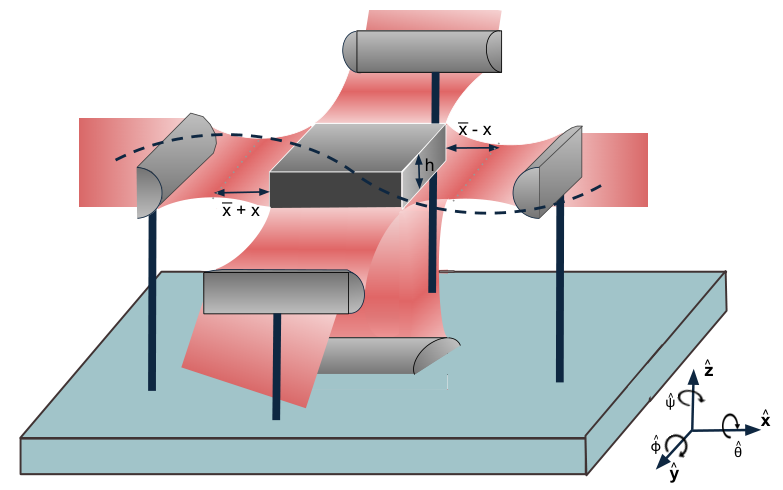
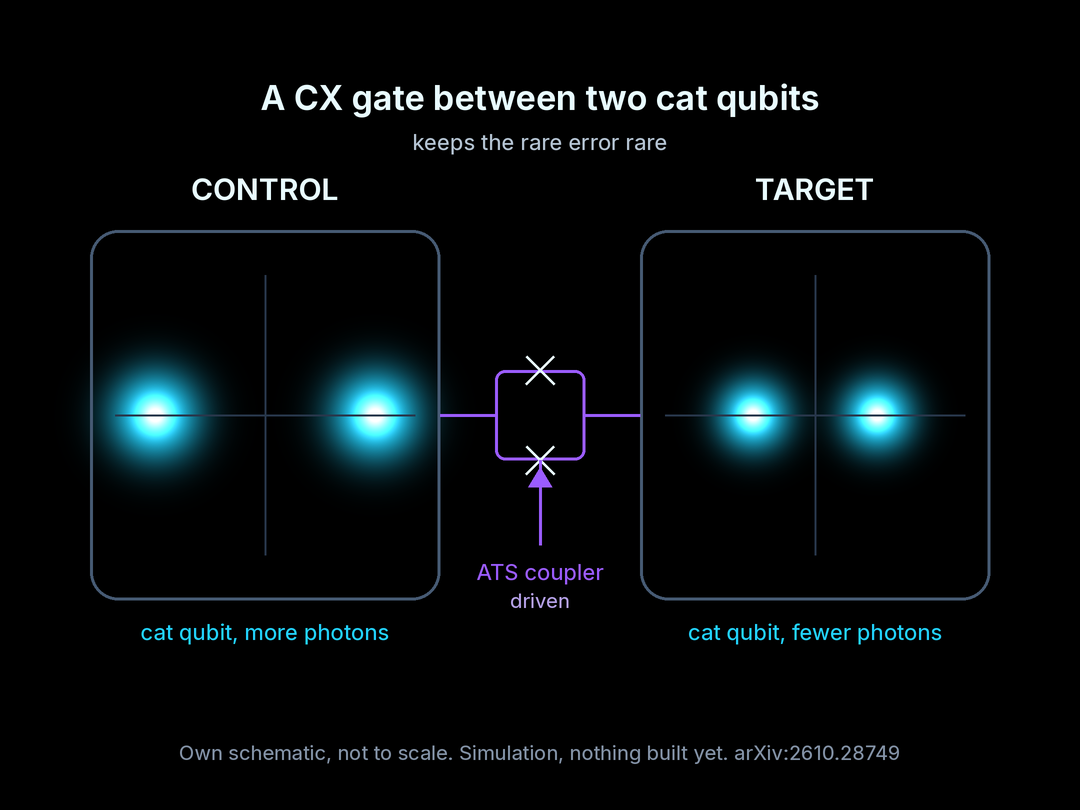
Kerr-cat qubits suppress bit-flip errors exponentially in the mean photon number, while phase-flip errors grow only linearly. Entangling gates must keep that imbalance, so that phase flips during the gate do not turn into bit flips. The authors propose an asymmetrically threaded SQUID (ATS) used as a parametric coupler between two resonators, each holding a Kerr-cat qubit, and a larger photon number in the control than in the target, which suppresses leakage without complex pulse shaping. In numerical simulations of the coupler circuit, with the Kerr-cat modes described by effective terms, their CX gate reached an average gate fidelity of 99.69 % in 50 ns without photon loss, and 99.86 % in 100 ns. The dominant error without loss is leakage out of the code space. With a single-photon loss rate κ/2π = 100 kHz the noise bias was about 9922, against about 17 for a naive CX gate, which the authors give as a factor of about 570. The authors chose this high loss rate as a stress test: there the gate fidelity is 77.53 %, close to the idling fidelity of 77.72 % over the same time. At κ/2π = 0.75 kHz the gate reaches 99.48 % with a noise bias of about 1150.
Why it matters
The authors present the coupler as a building block for concatenated cat-qubit architectures, which need entangling gates that keep the bias. Because the ATS is already a standard element in superconducting bosonic hardware, they argue that the scheme needs no new nonlinear components. This is a simulation study. No device has been built. The paper is a preprint and not yet peer-reviewed.
What is still open
The authors name the next step themselves: an experimental demonstration of the two coupler interactions. They list the strong parametric drive on the ATS, which produces residual drives and can excite the coupler, as the main challenge.
The authors note: “A primary challenge is the strong parametric drive on the ATS. It produces residual linear drives, which we compensate (Appendix F), and it can excite the coupler (Appendix B.3).” (Section IV, Conclusions)