A quantum link across a city, through ordinary rented fibre
Preprint, not yet peer-reviewed | Experiment
Trapped-ion repeater nodes had so far been tested only with fibre on spools in the lab, and this one runs over 17 km of fibre already installed in a city.
Our understanding
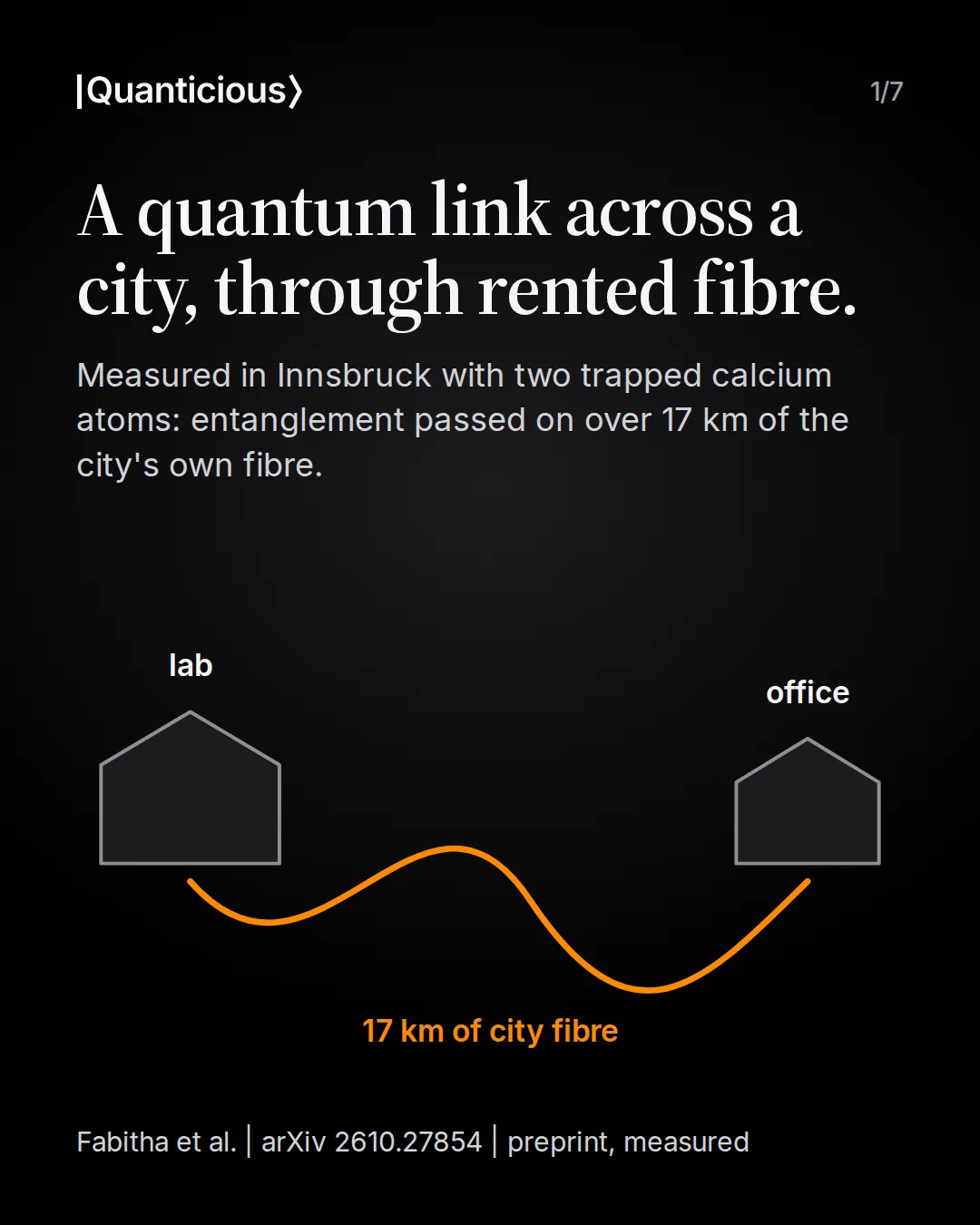
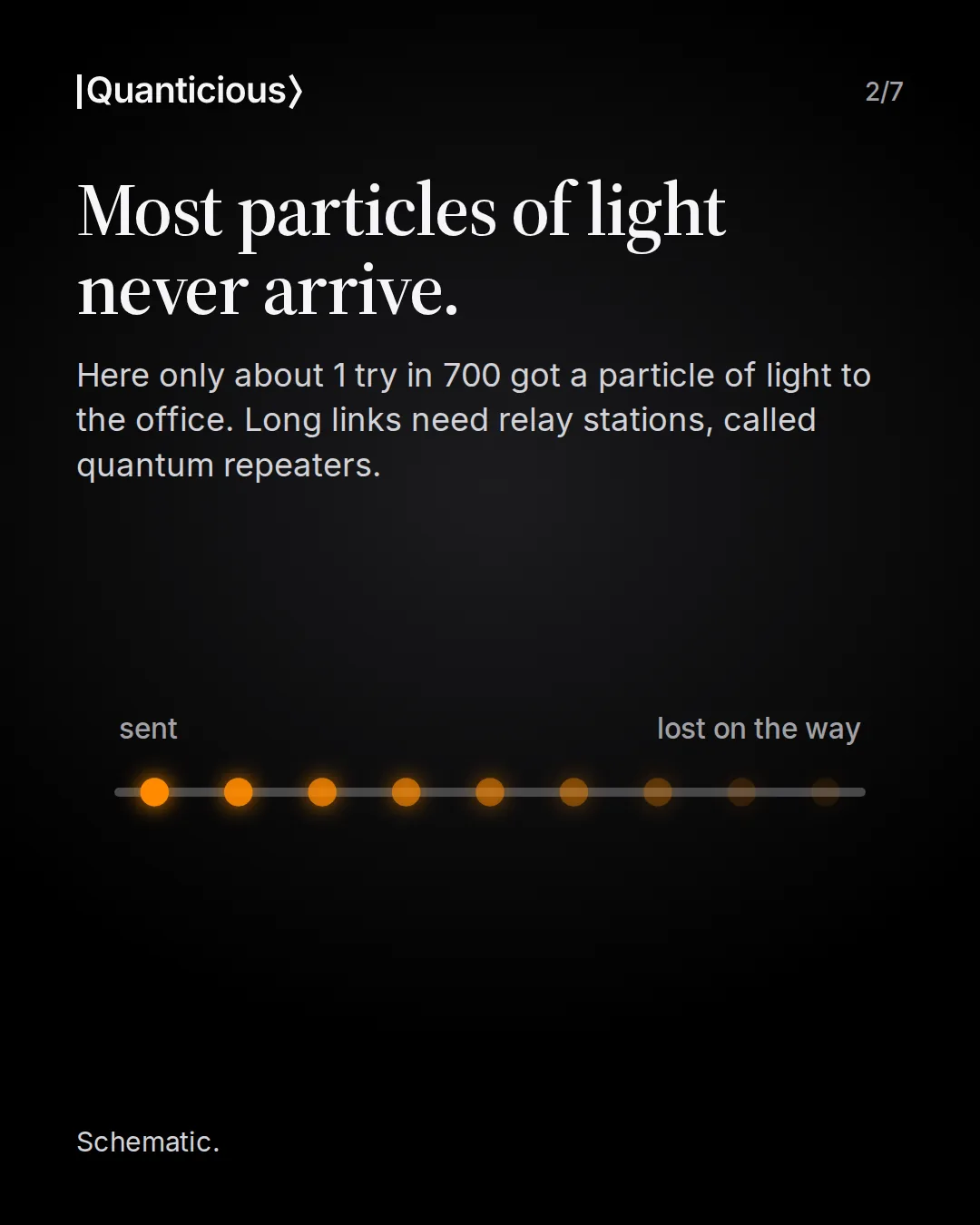
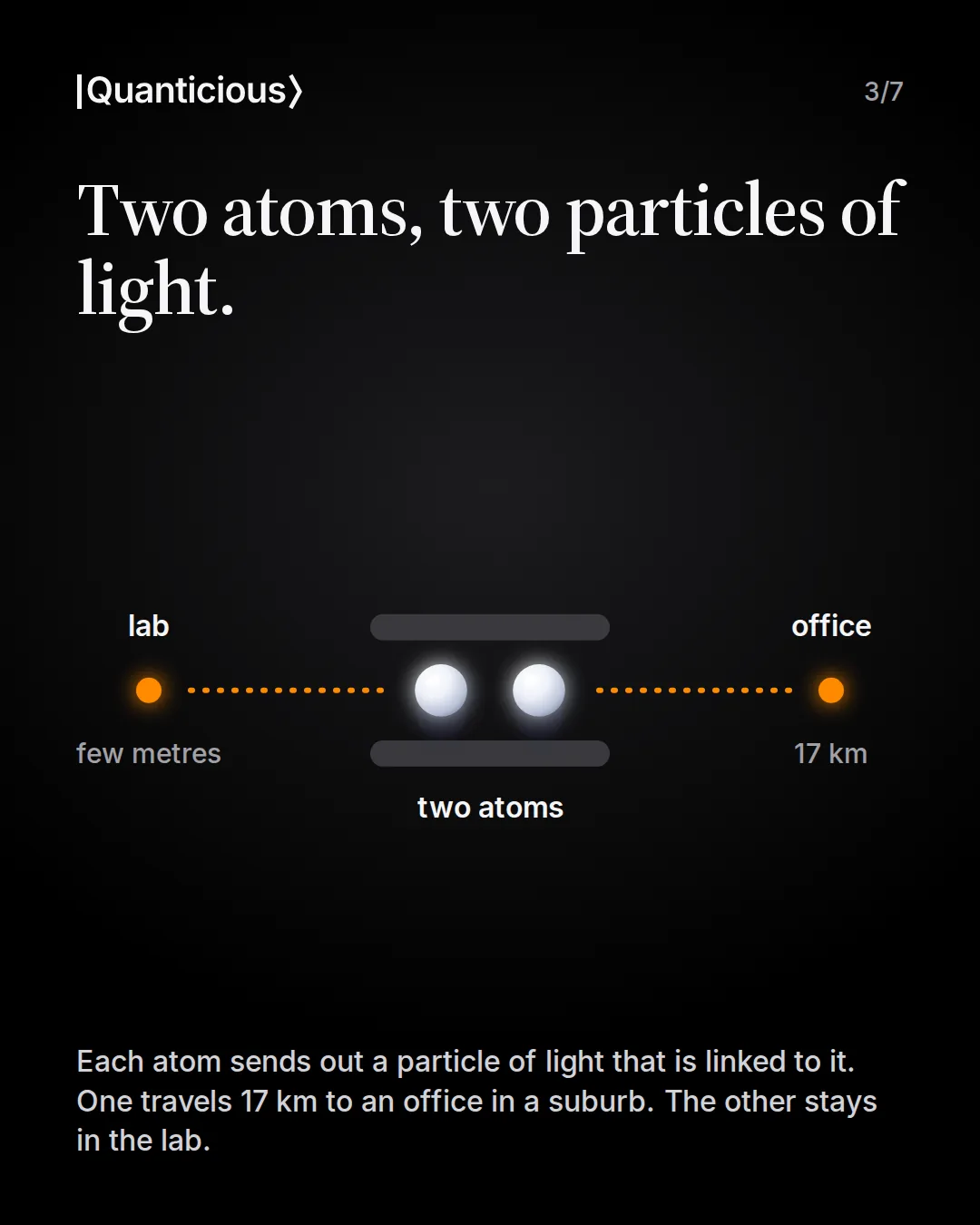
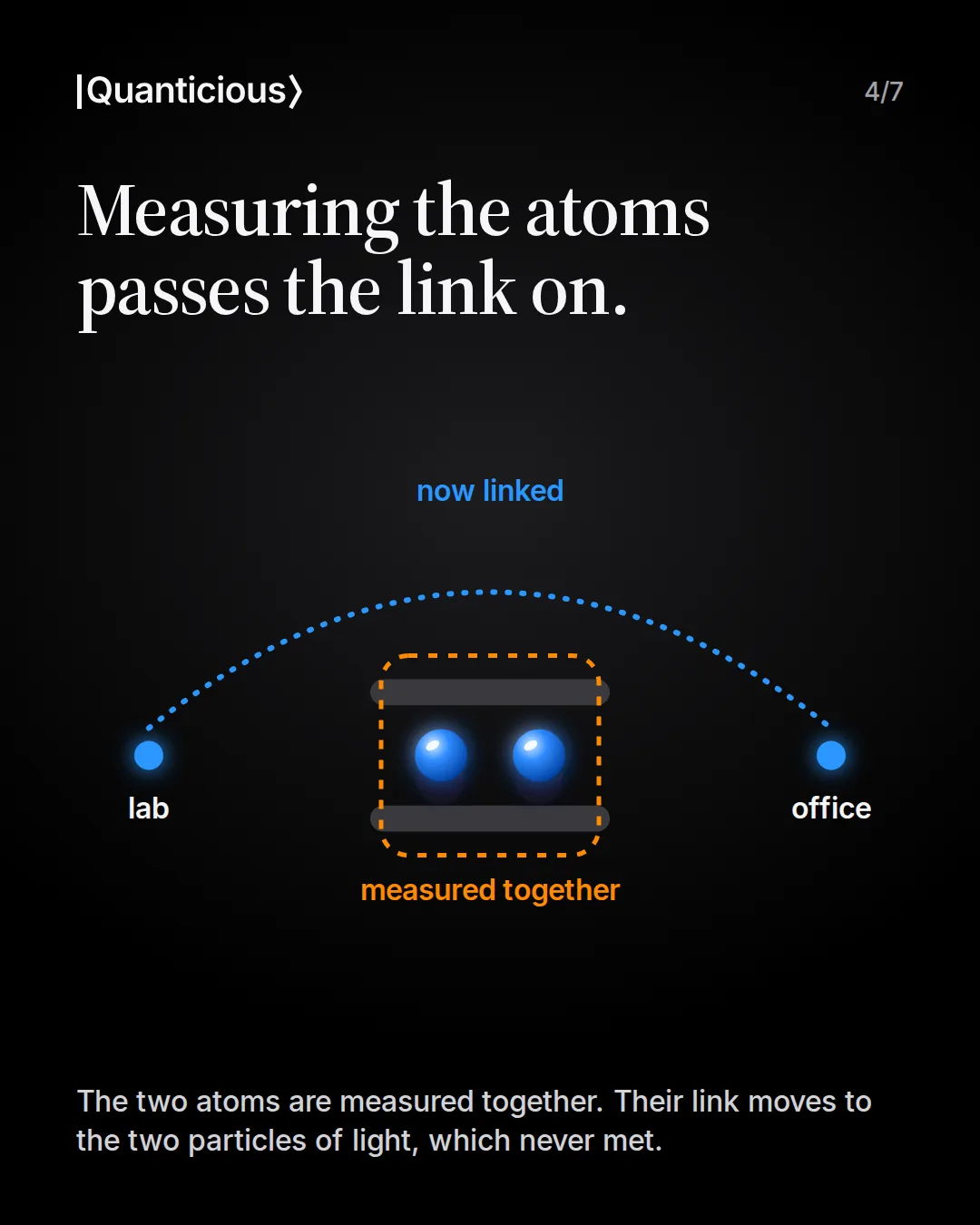
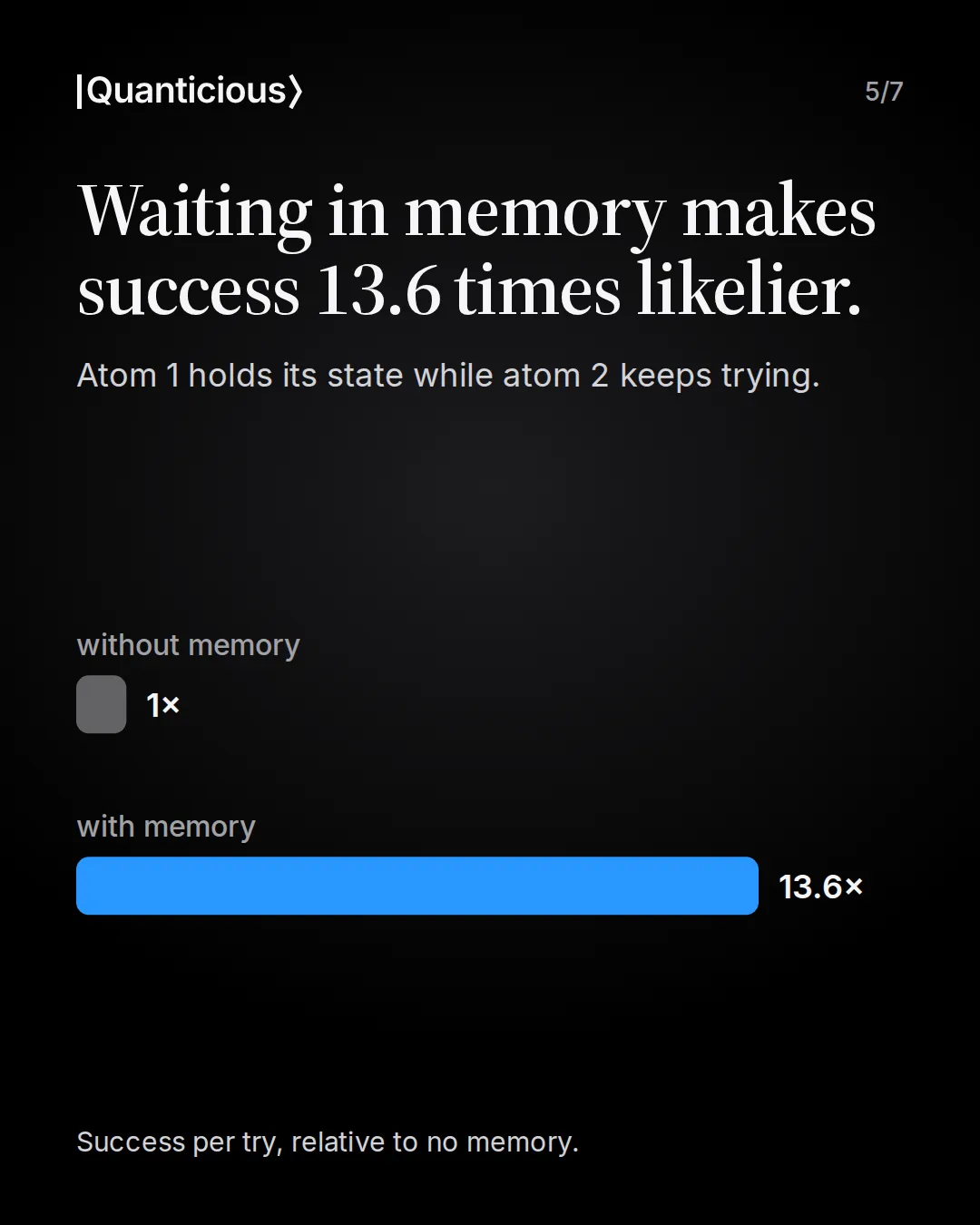
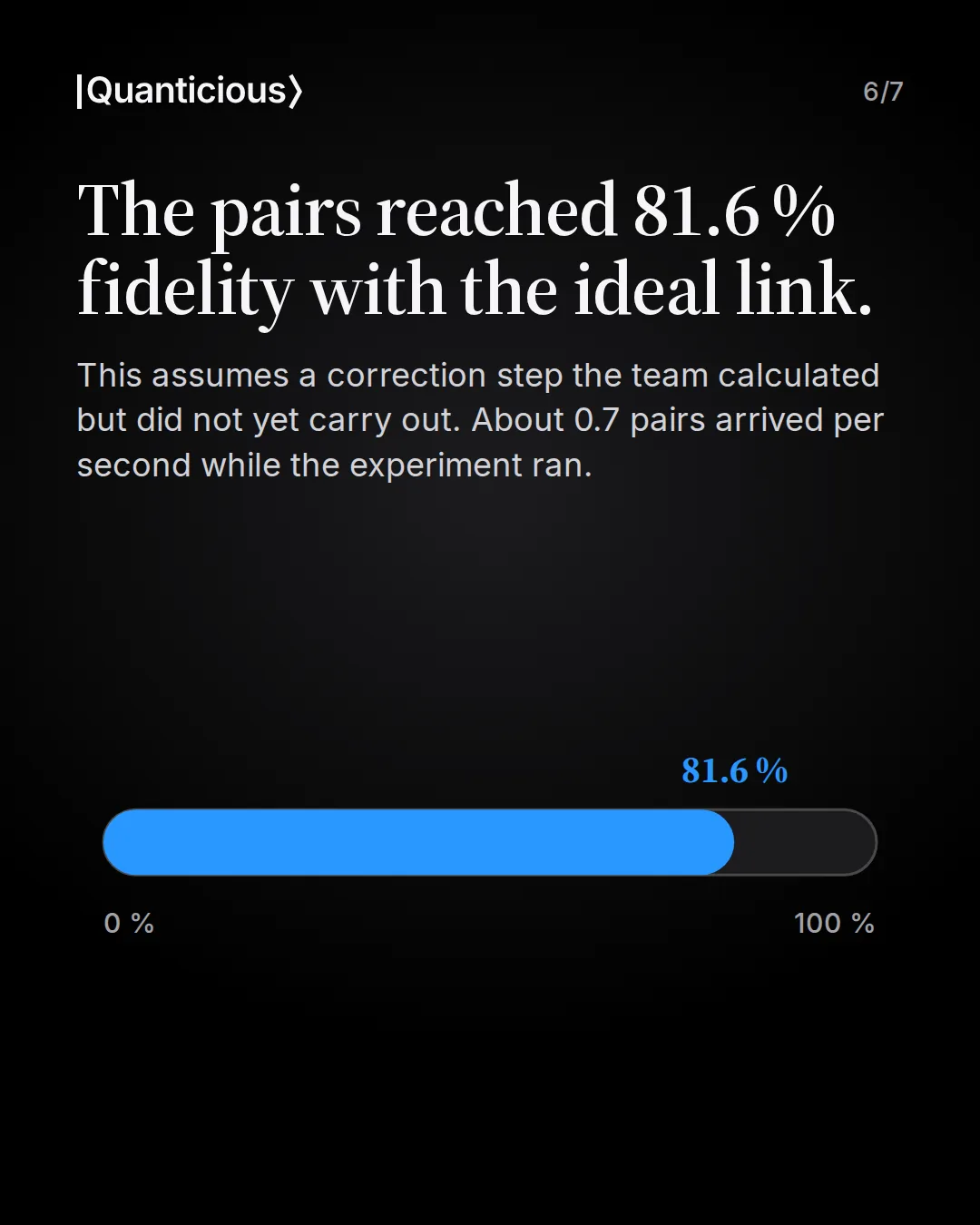
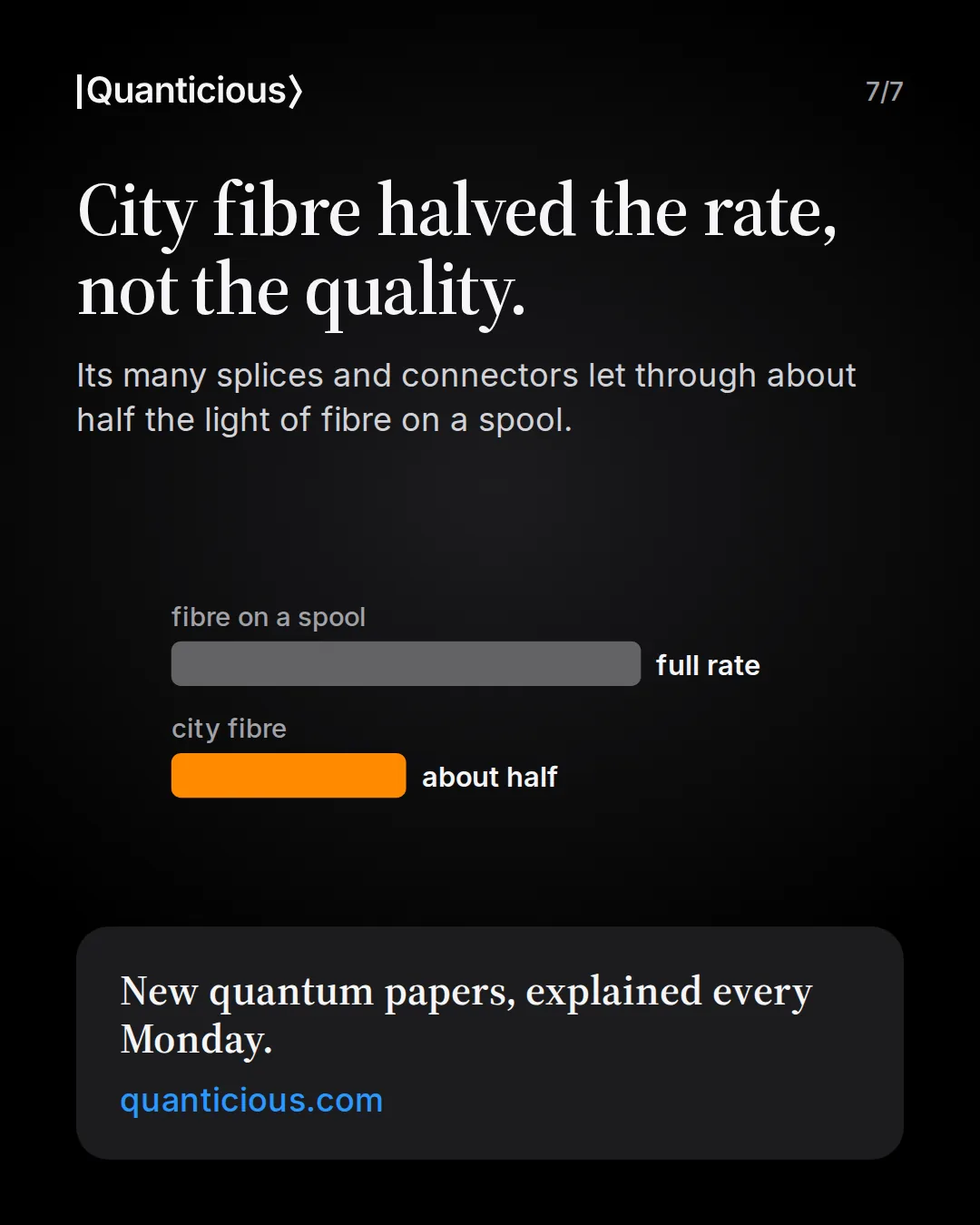
One way to send quantum information over long distances is a chain of relay stations, called quantum repeaters. In Innsbruck, a team built one from two single calcium atoms held in a trap. Each atom sends out a particle of light that is linked to it. Then the two atoms are measured together, and the link passes to the two particles of light. One of them stayed in the lab, the other travelled through 17 km of fibre rented from the city’s utility company to an office in a suburb. The two particles of light reached a fidelity of 81.6 % with the ideal linked state. That value assumes a final correction step that the team calculated but did not yet carry out on the light. Without it, the four measured states reached 78 to 84 %. About 0.7 such pairs arrived per second while the experiment was running, not counting breaks for calibration. The city fibre itself barely hurt the quality. Its many splices and connectors halved the rate compared with fibre on a spool. The paper is a preprint.
A few papers like this every Monday, free.
Free. Unsubscribe anytime. Privacy
The details
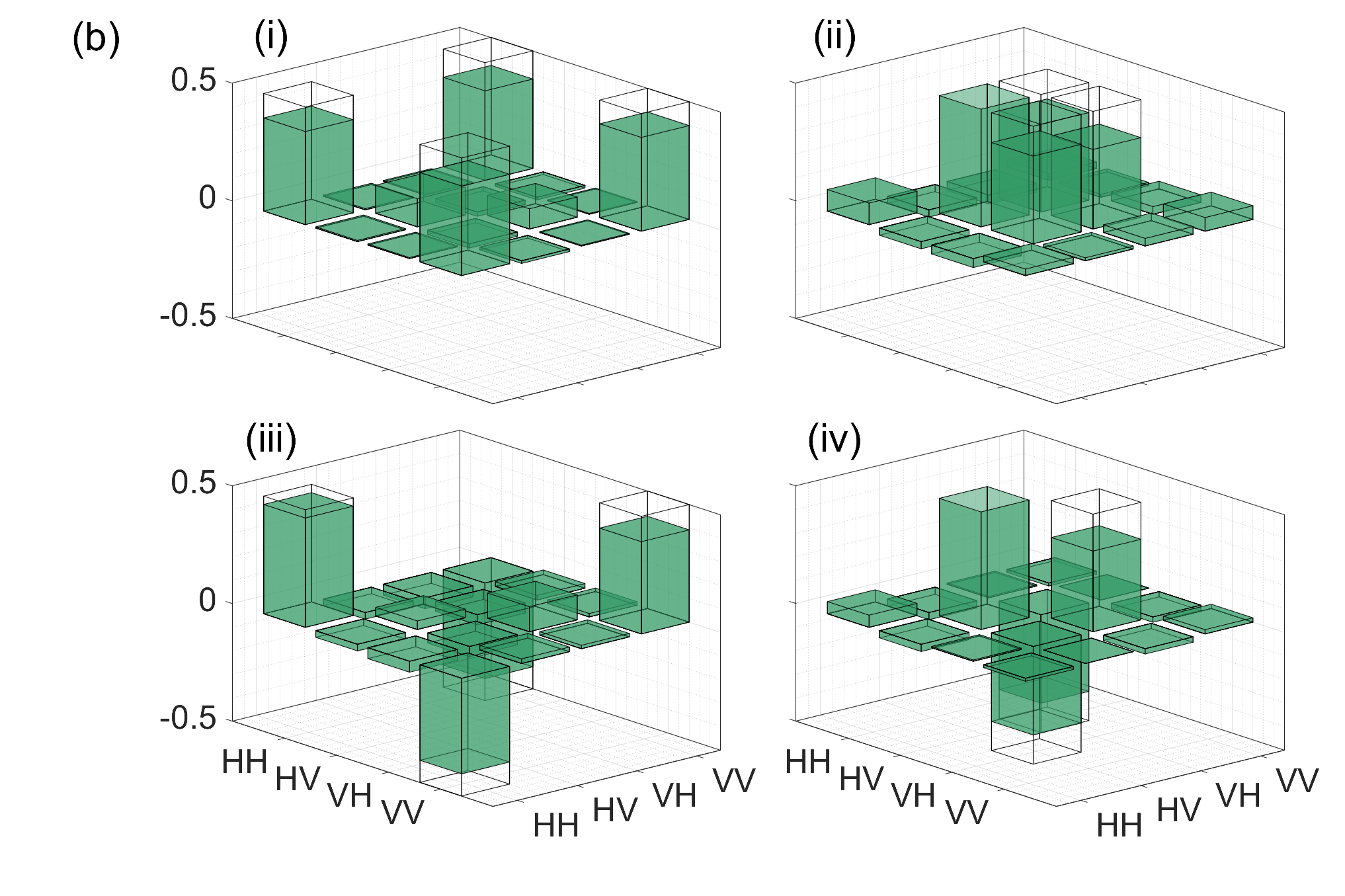
Key number: Photon-photon Bell-state fidelity 81.6 (+1.9/−1.4) % with numerically simulated feedforward (measured states without feedforward 78 to 84 %), at 0.69 pairs per second of running time (81 minutes of a 4.5-hour session, the rest went to calibration) over 17 km of deployed city fibre
What they did
The repeater node holds two ⁴⁰Ca⁺ ions in a linear Paul trap with an integrated 20 mm optical cavity in a lab in Innsbruck. Ion 1 emits a photon entangled with it, which is converted from 854 nm to 1550 nm and sent through 17 km of rented, already installed fibre to an office in a suburb, 5.2 km away in a straight line. Once that photon is detected, ion 2 emits a second photon that is detected in the lab after a few metres of fibre, while ion 1 waits in a memory protected by dynamical decoupling. A Mølmer-Sørensen gate and readout of both ions then act as a deterministic Bell-state measurement that swaps the entanglement onto the two photons. The four measured photon-photon states reached Bell-state fidelities of 78 to 84 %. With feedforward simulated numerically, the delivered state would have a fidelity of 81.6 (+1.9/−1.4) %. 3369 successes in 81 minutes of running give 0.69 pairs per second, and the ion memory raised the success probability per attempt by a factor of 13.6 ± 0.4.
Why it matters
Earlier trapped-ion repeater nodes were tested with spooled fibre in the lab. Here one fibre segment runs through a city’s existing network, and the authors find that it did not significantly add to the infidelity. Its transmission of 0.192, against about 0.46 expected for typical fibre of that length, roughly halved the rate. The authors name the main error sources: dark counts of the remote detectors, noise photons from the frequency conversion, imperfect ion-photon states and memory decoherence from magnetic-field noise. As a next step they sketch a chain over 68 km of fibre with improved nodes that get a photon detected at the remote station about seven times more often than here (probability 10⁻² instead of 1.38 × 10⁻³). For that chain they calculate a mean time of 5.4 s to herald stored entanglement, needing ion memories coherent for about 3.6 s. The paper is a preprint and not yet peer-reviewed.
What is still open
The feedforward was simulated, not carried out on the photons, and the authors write that they have not yet identified part of the infidelity of the locally detected photon. Storing entanglement between two distant ions is the next step they name.
The authors note: “If we were able to implement perfect feedforward to the photon-photon states, this is the fidelity of the state that would be delivered.” (Section IV)