A proposed dark matter detector: a glass plate floating on laser light
Peer-reviewed in Physical Review Research | Proposal
It moves optical levitation from nanoparticles to a 0.2 mg plate and gives what the authors call the first systematic optimisation of quantum noise in optically trapped systems.
Our understanding
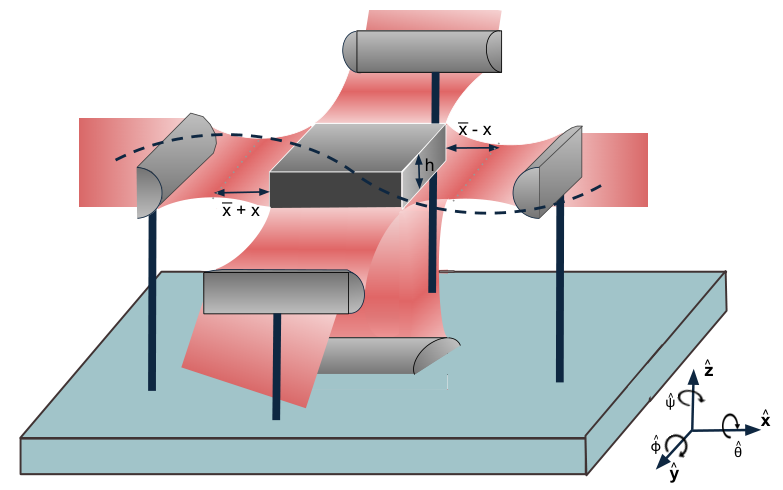
Some candidates for dark matter would gently and rhythmically push on ordinary matter, a little differently depending on what the matter is made of. To feel such a tiny push, the sensor should be heavy and almost free of friction. A team with authors in Germany, Italy, the UK and the US proposes a coated glass plate of 0.2 mg, 3.5 mm wide, that floats on laser light. A beam of about 300 W from below carries its weight, and beams from the sides hold it in place. The authors calculate that the sensor could reach the standard quantum limit, the noise floor set by the measurement itself, with equipment that can be bought today, down to signals of about 5 Hz. Below that, ground vibrations take over. In the near term, the design could beat existing searches for one kind of dark matter by up to half an order of magnitude. It is a design study. No plate has floated yet.
A few papers like this every Monday, free.
Free. Unsubscribe anytime. Privacy
The details
Key number: Projected for a 0.2 mg plate: quantum-noise-limited operation down to about 5 Hz, and up to half an order of magnitude beyond fifth-force tests and LIGO searches for B minus L dark matter masses of 1.5 × 10⁻¹⁴ to 2 × 10⁻¹³ eV (near-term design, no uncertainty given)
What they did
Several models of ultralight dark matter predict feeble oscillating forces on macroscopic objects that depend on their composition. The authors propose a tunable optically trapped sensor for such forces: a coated plate of 0.2 mg and 3.5 mm × 3.5 mm whose high aspect ratio lets a vertical 1064 nm beam of about 300 W carry its weight without excessive heating, with side beams trapping it. The setup sits in a cryogenic box at about 4 K and a vacuum of 10⁻¹² mbar. The authors present a systematic analysis and optimisation of the quantum noise in optically trapped systems and find that the minimum quantum noise occurs off resonance. They project that the sensor reaches the standard quantum limit with off-the-shelf technology down to signal frequencies of about 5 Hz, where seismic noise becomes dominant. In the short term the projected sensitivity to vector B minus L dark matter beats fifth-force tests and LIGO searches by up to half an order of magnitude for masses from 1.5 × 10⁻¹⁴ to 2 × 10⁻¹³ eV (arXiv version 2512.00166v2, Section VI).
Why it matters
Optically trapped sensors had been little explored for these forces, and most work used nanoparticles. The authors argue that heavier objects in the geometric optics regime give a better signal-to-noise ratio as long as classical noise stays under control. A heavier plate of about 0.8 g could reach further, if the trapping power can be obtained. It is a design study, peer-reviewed in Physical Review Research. No plate has been levitated yet.
What is still open
The authors list what could improve the reach: a heavier plate of about 0.8 g, longer integration time, squeezed light and arrays of sensors. Whether a 0.2 mg plate can be levitated stably as designed has still to be shown in the lab.
The authors note: “our experiment is capable of operating in the quantum-noise limited (SQL) regime down to frequencies of f_DM ≈ 5 Hz whereupon seismic noise becomes dominant” (arXiv v2, Section VI)