Two quantum chips, joined by a cable you could hold
Preprint, not yet peer-reviewed | Experiment
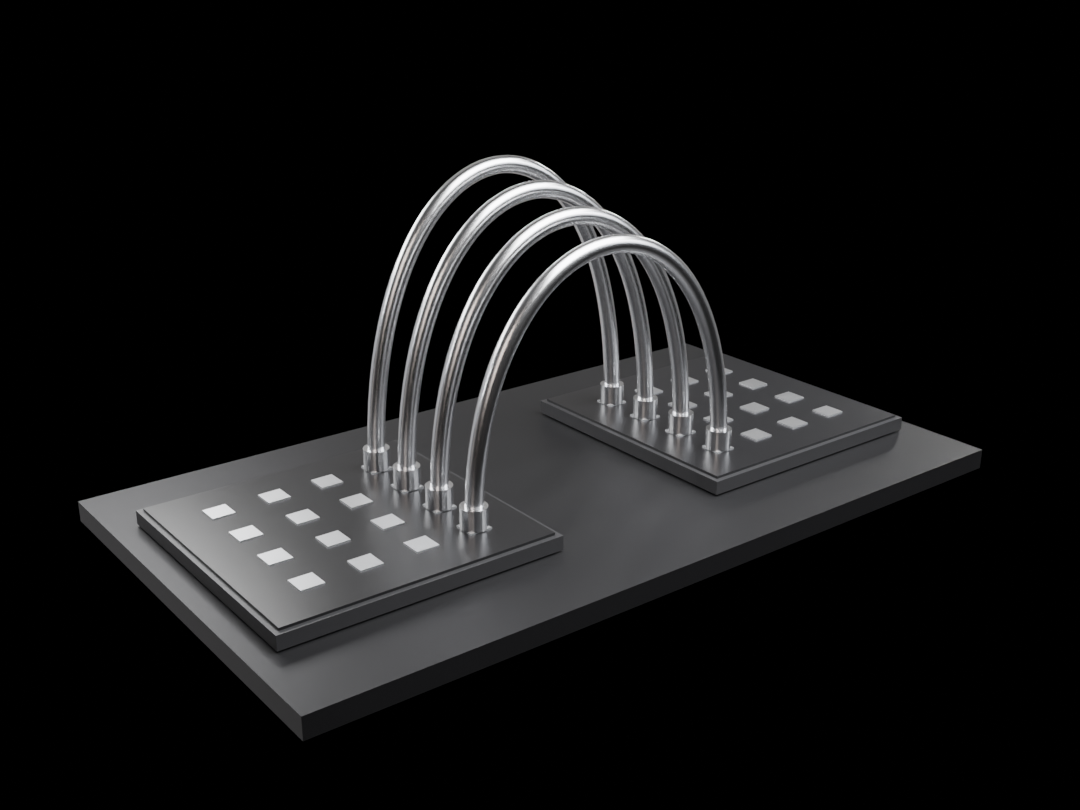
Many earlier cable links joined few-qubit chips with a single cable. This one joins two 120-qubit processors with four cables, installed after both were mounted.
Our understanding
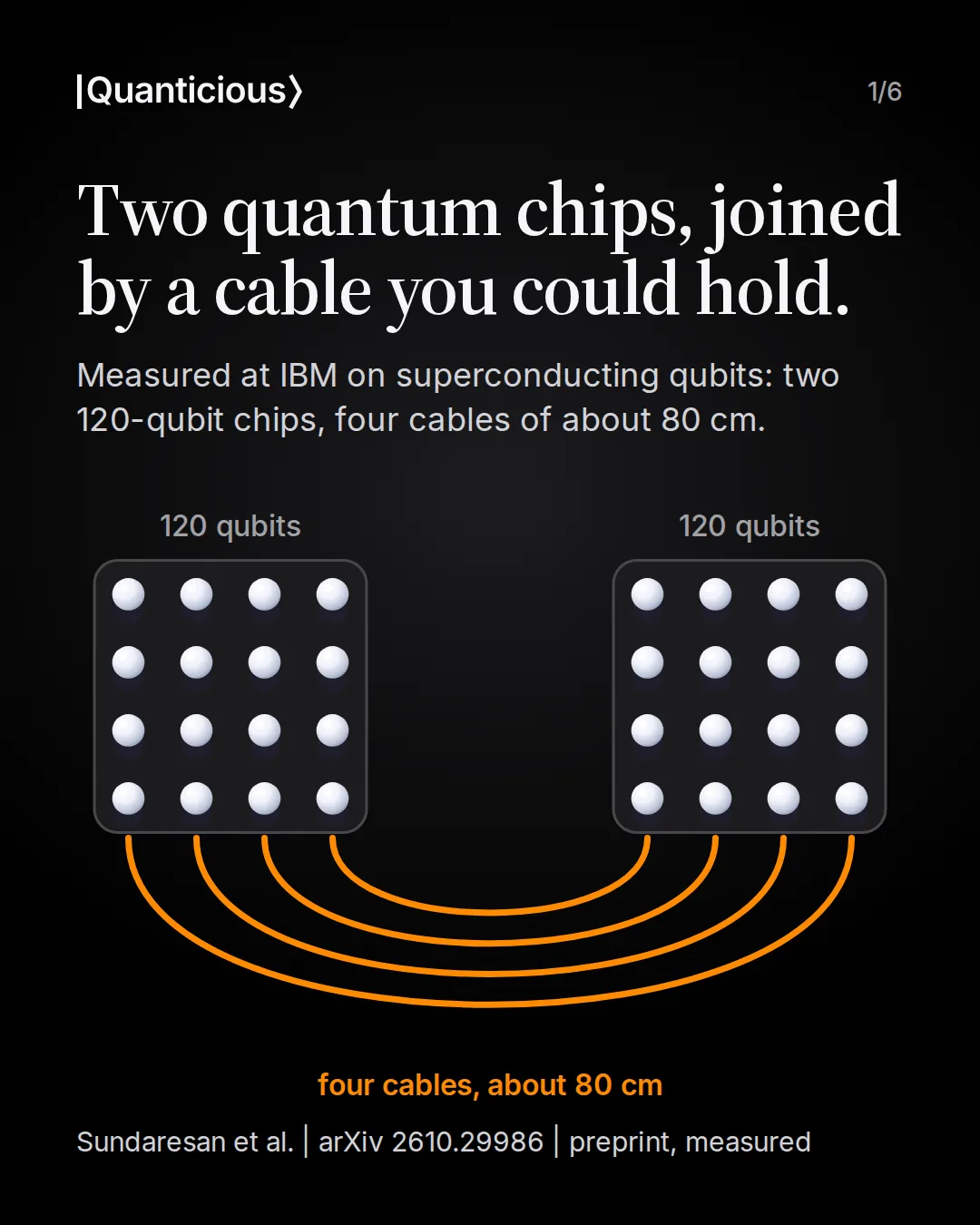
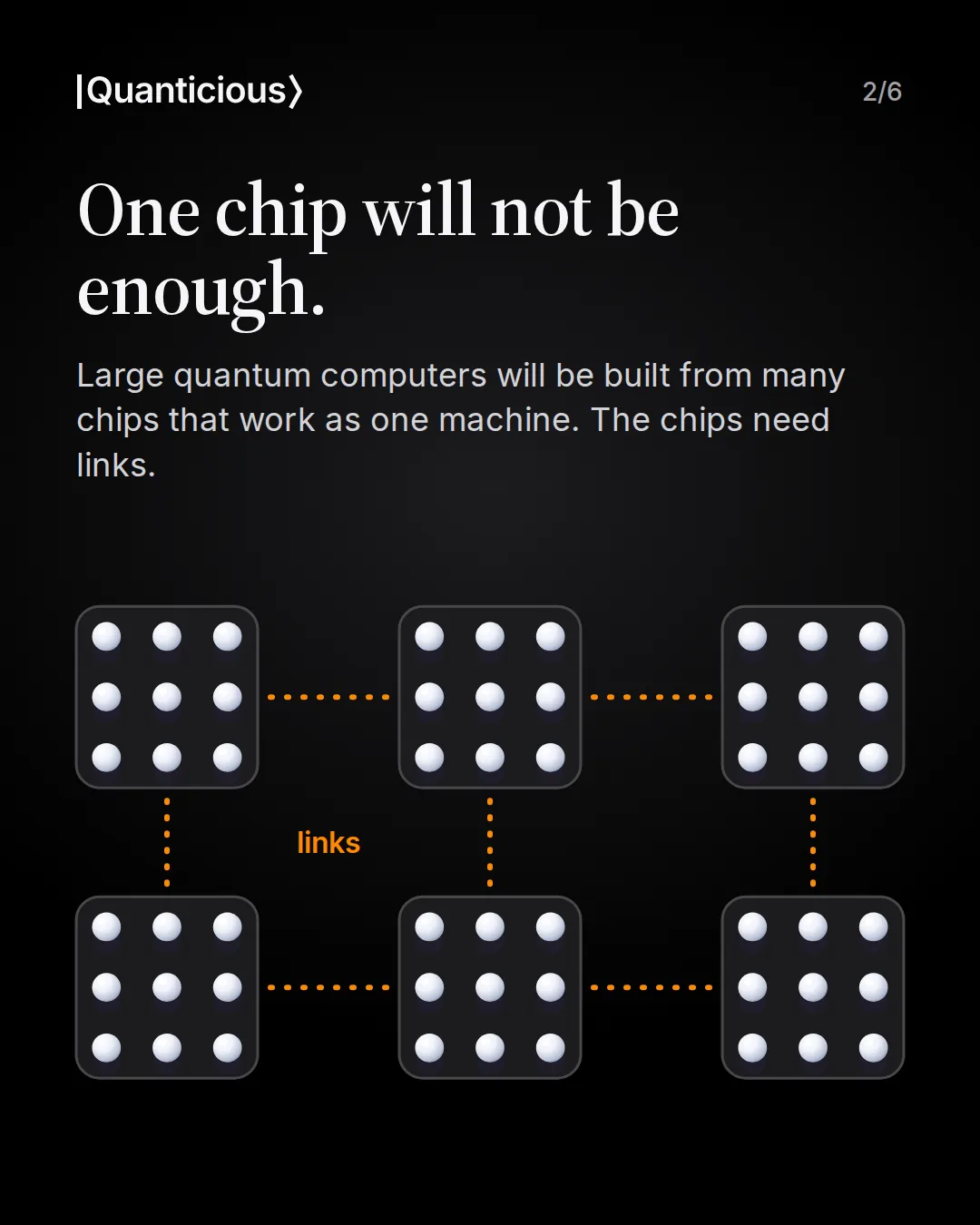
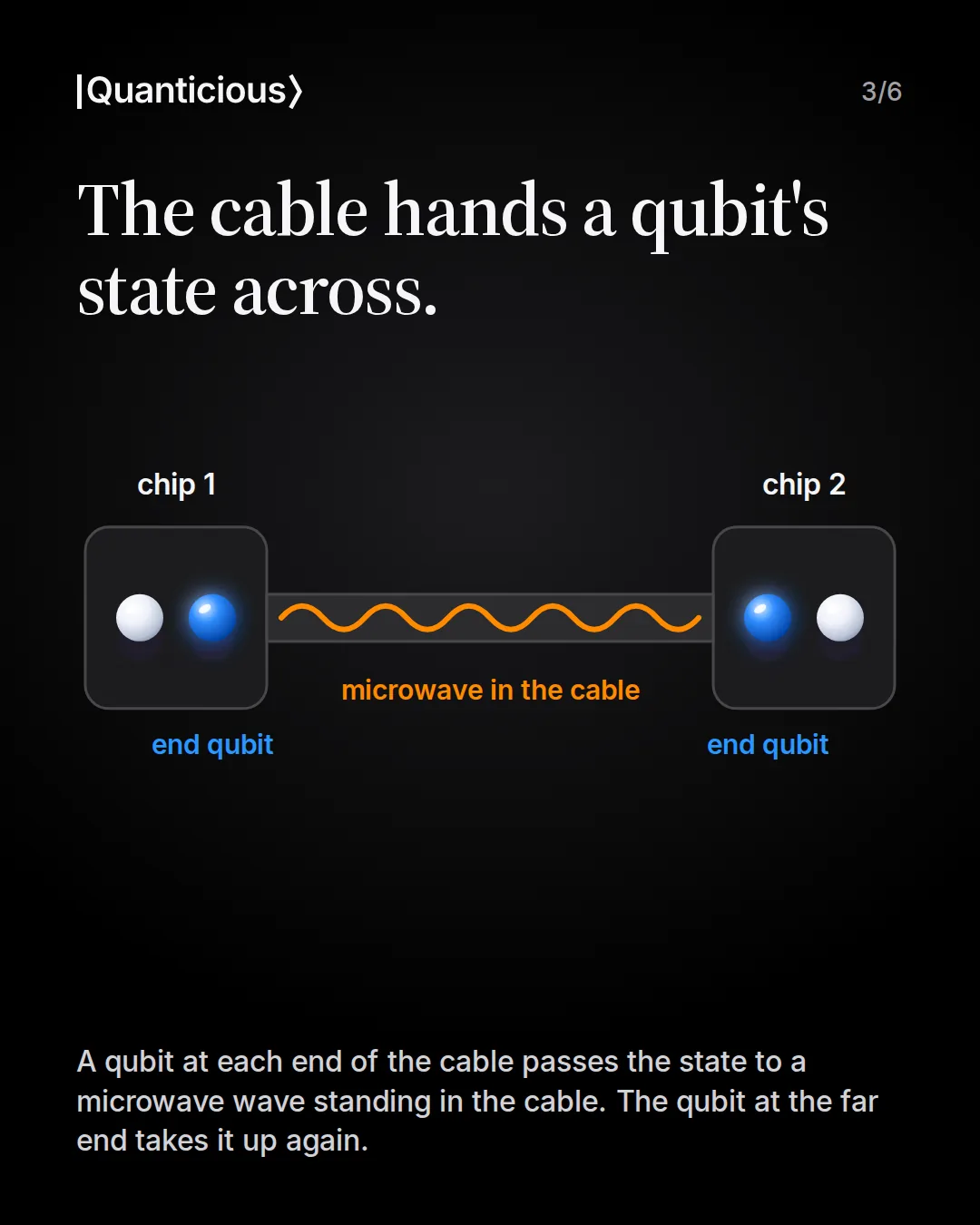
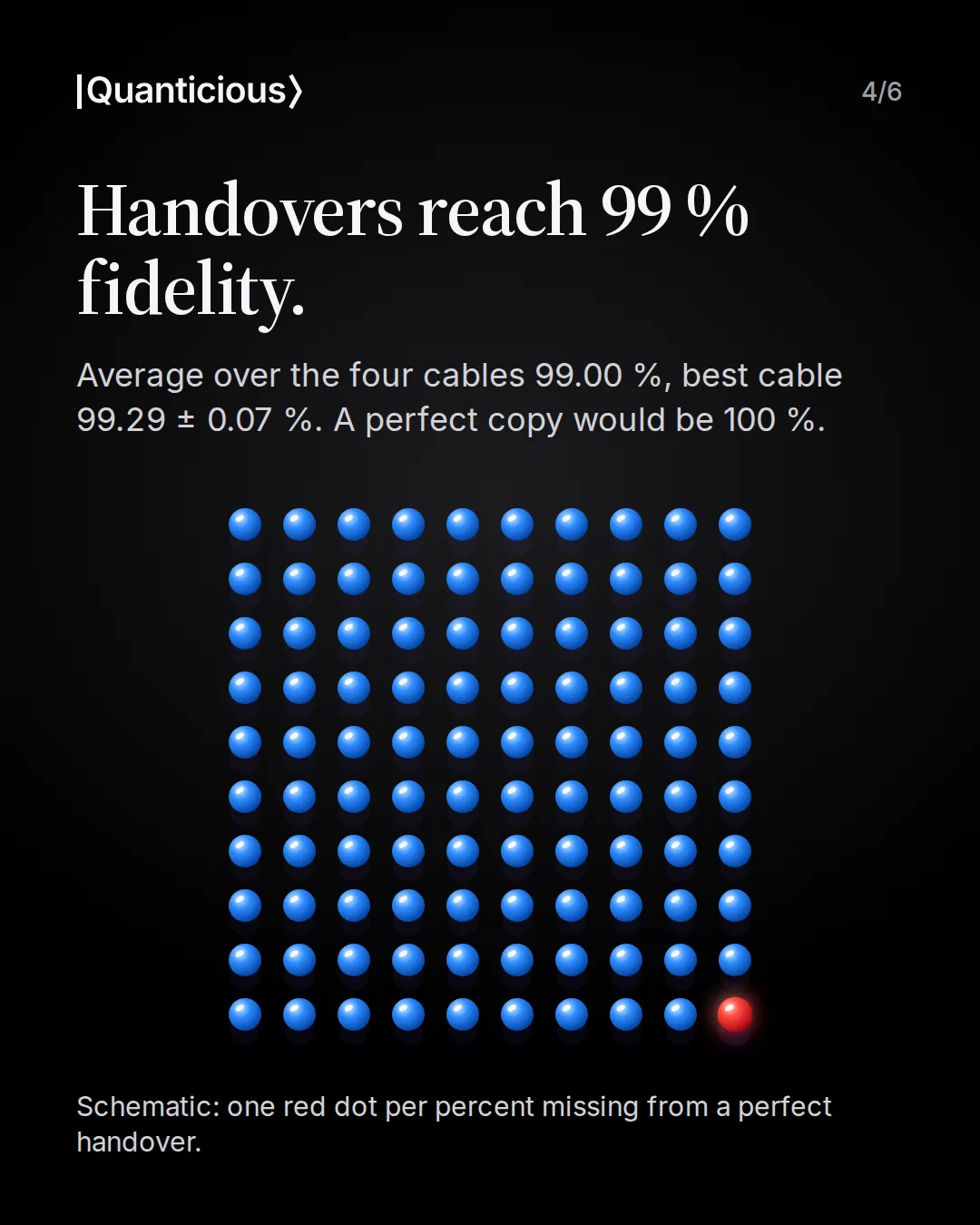
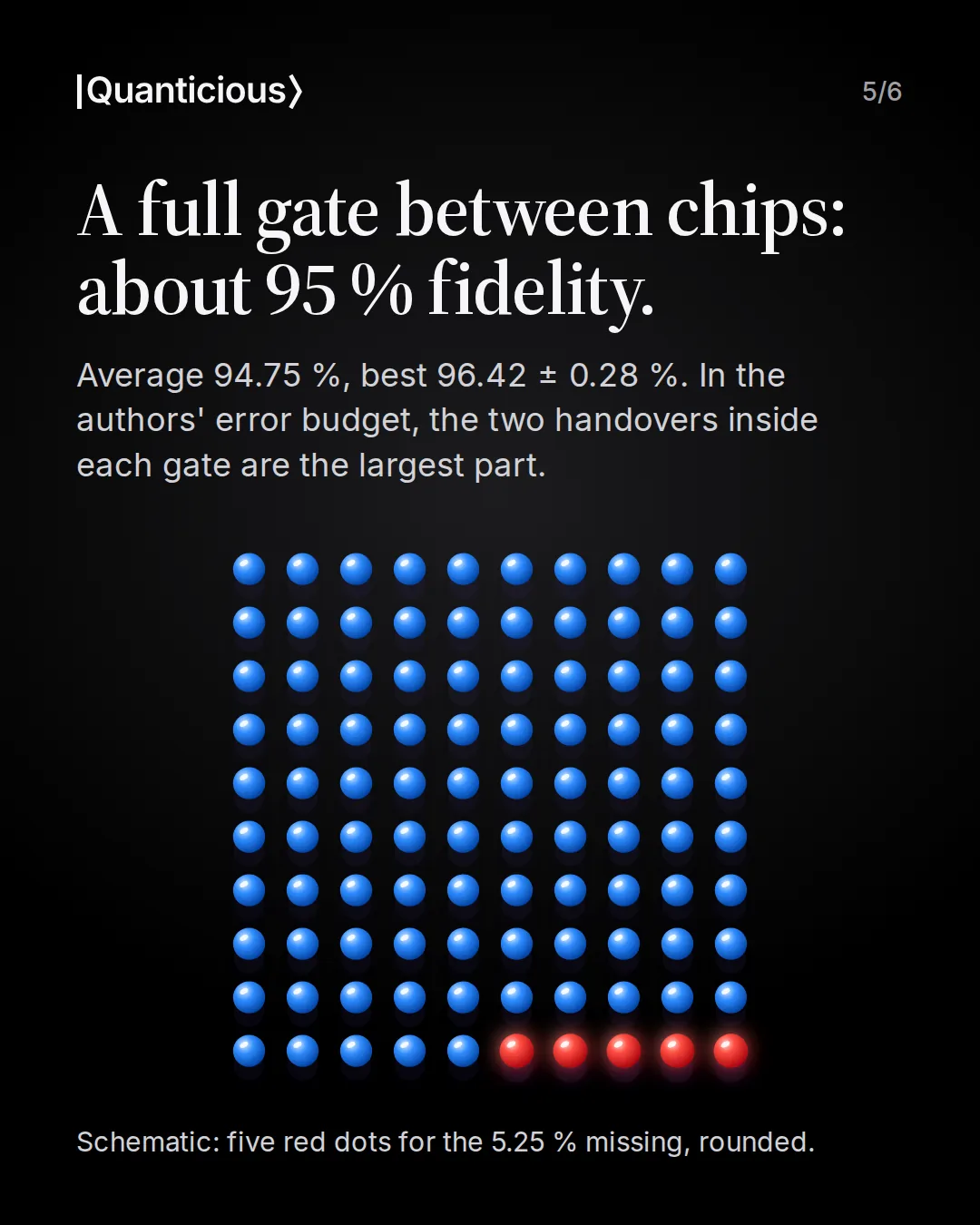

IBM plans to build large quantum computers from many smaller chips that work as one machine. For that, the chips need links that carry quantum information without spoiling it. A team at IBM joined two chips of 120 qubits each with four superconducting cables, each about 80 cm long. A qubit’s state handed across a cable arrived with an average fidelity of 99.00 %, and 99.29 % on the best cable, where 100 % would be a perfect copy. A full two-qubit operation between the chips reached 94.75 % on average. The authors note that splitting a machine into modules can pay off even when the links make about ten times more errors than operations inside a chip. In their model, most of the handover loss comes from the qubits at the cable ends, which the team deliberately built without the usual quality steps to save time. The cables kept working through three rounds of cooling down and warming up, without anyone touching them. The paper is a preprint.
A few papers like this every Monday, free.
Free. Unsubscribe anytime. Privacy
The details
Key number: State transfer fidelity 99.00 % (mean of four links, network benchmarking), best link 99.29 ± 0.07 %, and distant CZ fidelity 94.75 % (mean, randomized benchmarking), best 96.42 ± 0.28 %, between two 120-qubit Nighthawk R1 test modules
What they did
Modular quantum computers need links that carry quantum states between separate processor modules over meter-scale distances. The IBM team connected two 120-qubit Nighthawk R1 processors with four long-distance couplers (L-couplers). Each one joins two lattice qubits through two frequency-tunable L-qubits, two RF-SQUID based couplers and about 80 cm of superconducting aluminium coax. The cables stand perpendicular to the chips and were bonded with indium at room temperature after both modules were mounted in the cryostat. State transfer across the links reached a mean network benchmarking fidelity of 99.00 %, with a best link of 99.29 ± 0.07 %. Distant CZ gates between qubits in the two modules reached a mean fidelity of 94.75 %, with a best link of 96.42 ± 0.28 %, and the team used them to create Bell and GHZ states across both processors. The team also found that a magnetic field present while a cable cools through its superconducting transition degrades it, and shielded the cables with a double braid, which the authors regard as a temporary solution.
Why it matters
The links worked between two 120-qubit Nighthawk test modules rather than few-qubit chips, although only the qubits around the links were wired and measured, and all four stayed fully operational across three cooling cycles with the connections left untouched. The authors call it, to their knowledge, the first multi-channel quantum interconnect between large superconducting processors. They note that a modular design pays off even when links between modules have error rates an order of magnitude above gates inside a module, citing earlier studies. Their error model attributes 77 % of the transfer error to coherence, with L-qubit dephasing dominating, and with L-qubits at T1 = T2* = 100 µs it bounds transfer fidelity at 99.68 to 99.77 %. The paper is a preprint and not yet peer-reviewed.
What is still open
No cable connection was taken apart and rejoined in this work, and only a subset of qubits around the links was wired and measured. Whether fully fabricated L-qubits bring the distant gate close to the model’s bound is still to be measured (our inference).
The authors note: “we intentionally skipped fabrication and processing steps known to improve qubit coherence for development speed” (section State transfer, distant gates, and entanglement)