Secret keys from a truck, 10 km through open air
Preprint, not yet peer-reviewed | Experiment
By the authors' account it is the first field test in which one shared telescope carries both the quantum signal and all the classical data needed to finish and use the key.
Our understanding
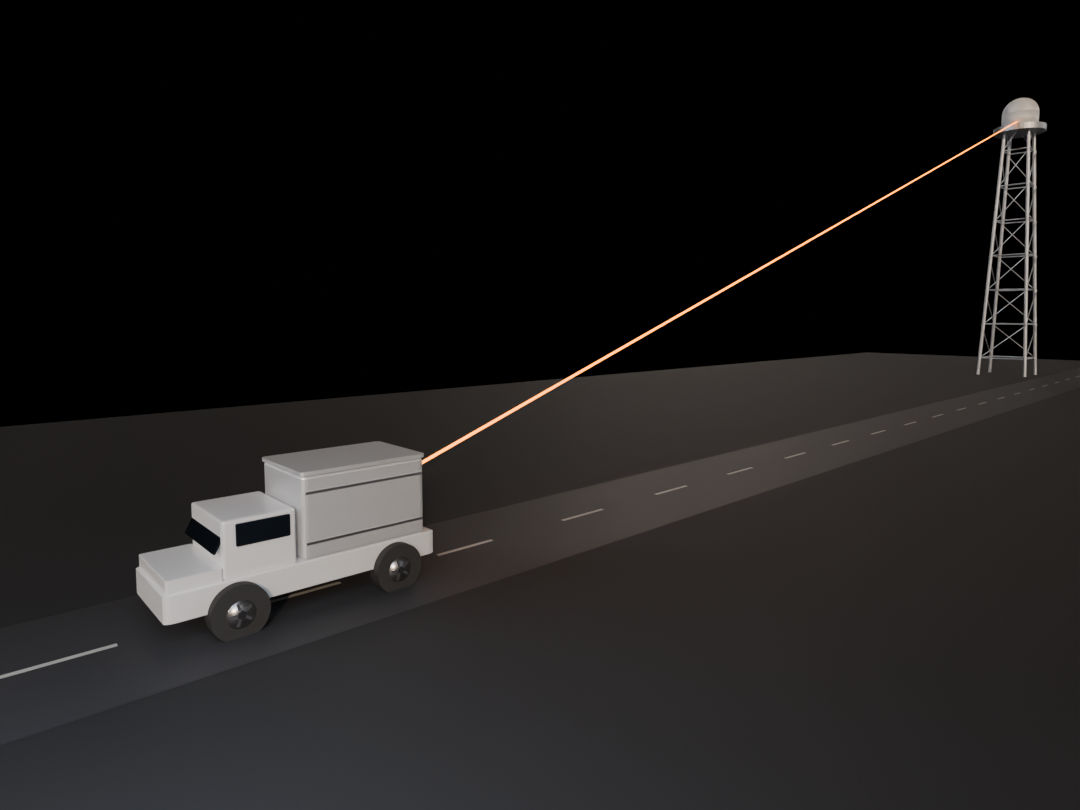
Quantum key distribution sends single photons, the smallest portions of light, to create a shared secret key, with security that rests on the laws of quantum physics. A team at Korea’s Agency for Defense Development mounted the sender on a pickup truck at an outdoor test site and aimed it at a tower 10.31 km away. The same telescope carried the single particles of light and an ordinary laser data link, which handled all the bookkeeping for the key. About 2.5 % of the key bits came out wrong, low enough to distil a secret key. The headline rate is 644 secret bits per second. The fine print matters: about one second of sending gave 687 secret bits, and turning the raw data into that key took 759 seconds, mostly for the data exchange. The authors write that this delay comes from a 10 MHz limit of their test electronics. The team then used the key to encrypt and send an image. The paper is a preprint.
A few papers like this every Monday, free.
Free. Unsubscribe anytime. Privacy
The details
Key number: 687 secret bits from 1.0666 s of quantum transmission (644 bit/s) at an average quantum bit error rate of 2.512 %, total failure probability 10⁻¹⁰, over a 10.31 km horizontal free-space link in clear weather
What they did
The team built a decoy-state BB84 quantum key distribution transmitter at 803 nm, with a 100 MHz pulse rate, into a shelter on a pickup truck set up at an outdoor site in Sejong. It sent to a receiver on a test tower of the Agency for Defense Development in Daejeon, 10.31 km away, in clear weather with visibility above 20 km. The same telescope aperture also carried a two-way classical laser link at 640 and 660 nm, which handled all key post-processing and the encrypted payload. The quantum bit error rate averaged 2.512 %. One finite key of 687 secret bits came from 1.0666 s of quantum transmission, a secret key rate of 644 bits per second, with a total failure probability of 10⁻¹⁰ (Table 2). The distilled key was then used for AES-256 encrypted image transmission over the same optical channel.
Why it matters
By the authors' account it is the first field test in which one shared aperture carries both the quantum channel and the complete classical post-processing and encrypted data, without a separate radio or fibre link. Table 2 also shows the cost of that design: post-processing took 759 s, of which 650 s were optical data transfer. The authors attribute the 650 s to the 10 MHz clock limit of their prototype FPGA and estimate about 26 s with laser modulation up to 250 MHz. The paper is a preprint and not yet peer-reviewed.
What is still open
The paper reports one finite key from about one second of transmission in clear weather. How the link performs over longer runs, in other weather and while the vehicle moves is not described (our inference).
The authors note: “the 650-second transmission duration required for post-processing auxiliary data was bounded strictly by the 10 MHz digital input/output clock limit of the prototyping evaluation FPGA” (Section III.D)