Reading out a quantum process directly, with help from an effective “time loop”
Peer-reviewed in Physical Review Research | Experiment
It turns the closed-timelike-curve formalism into a working photonic method for reading process matrix elements one by one and states what the method does not save.
Our understanding
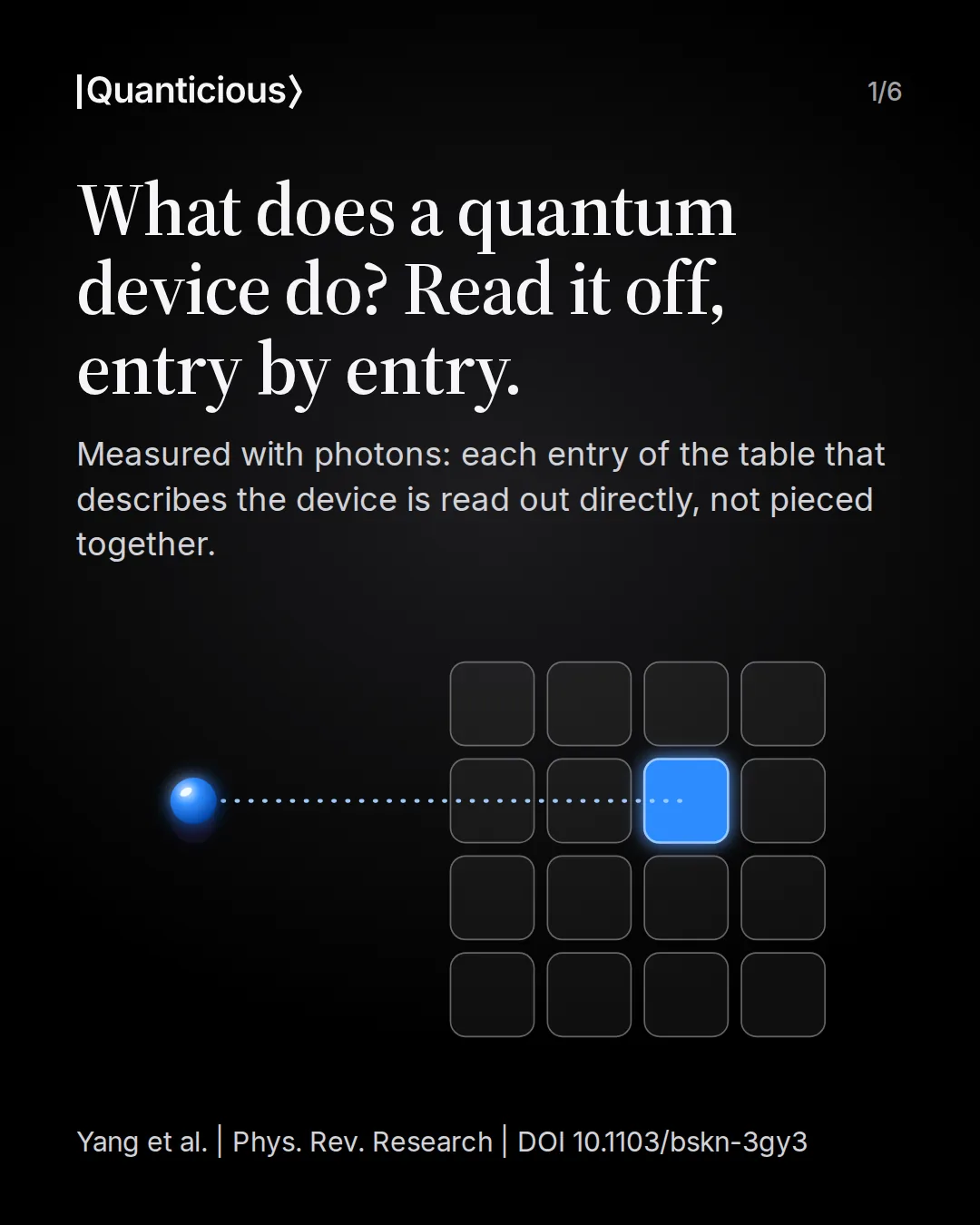
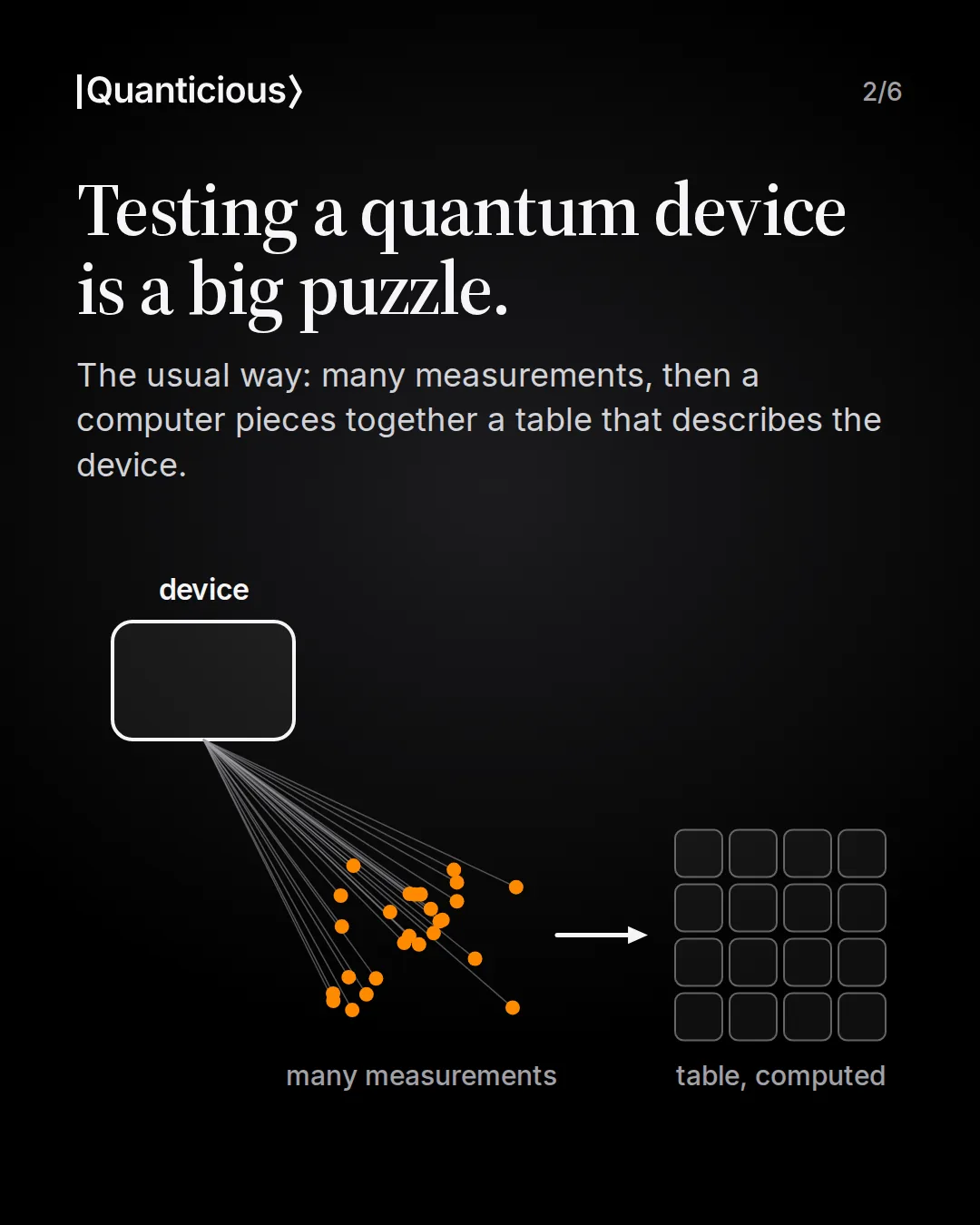
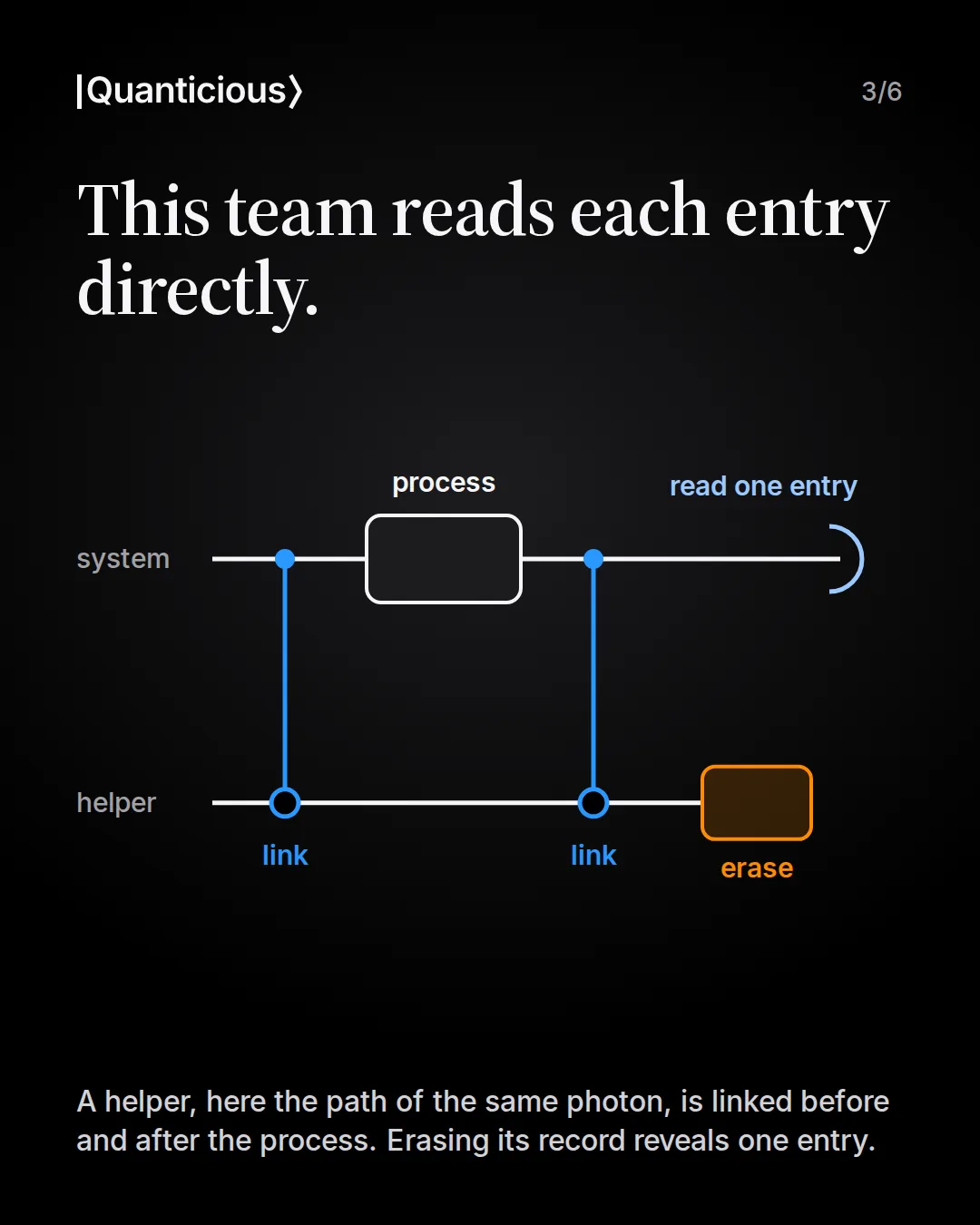
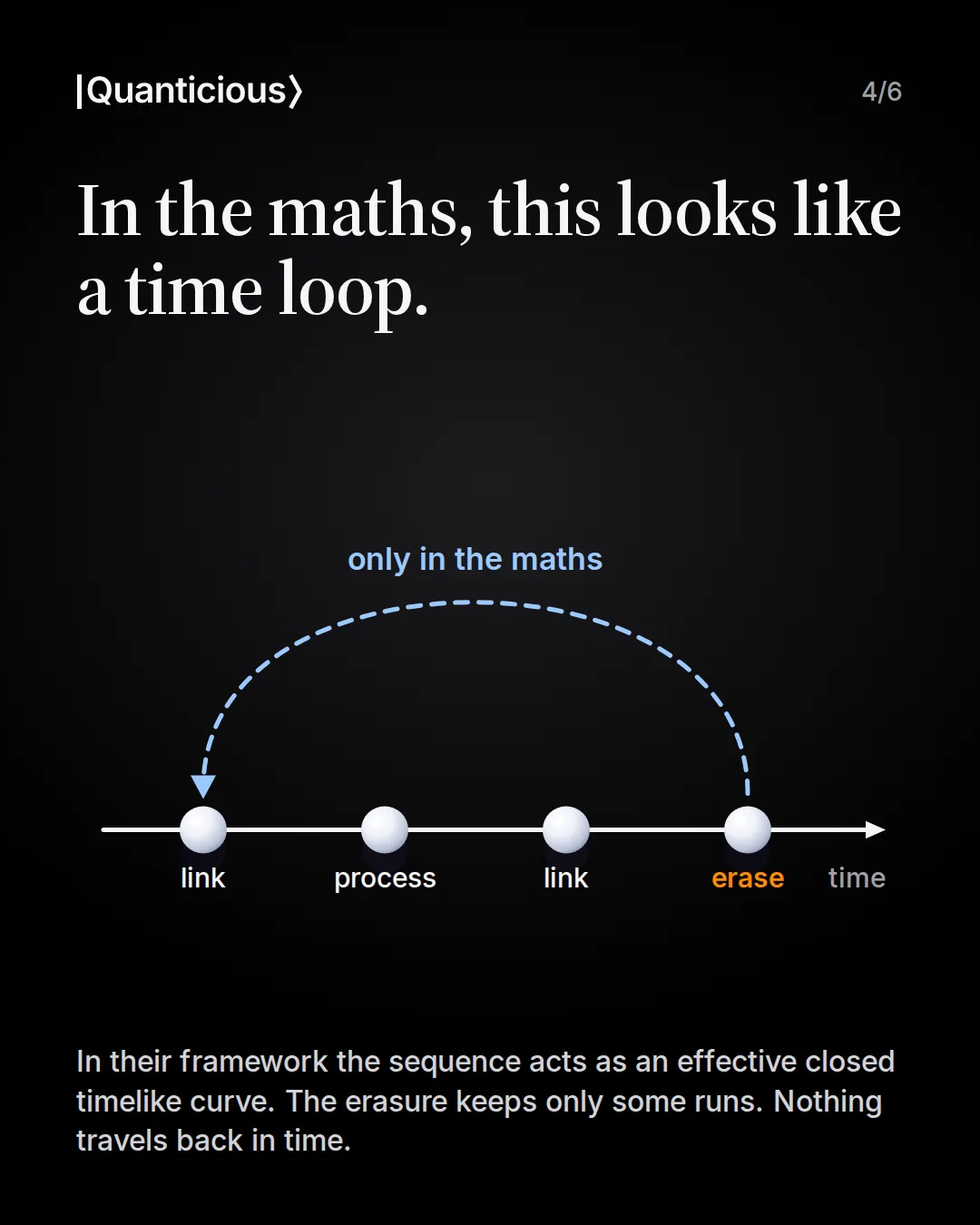
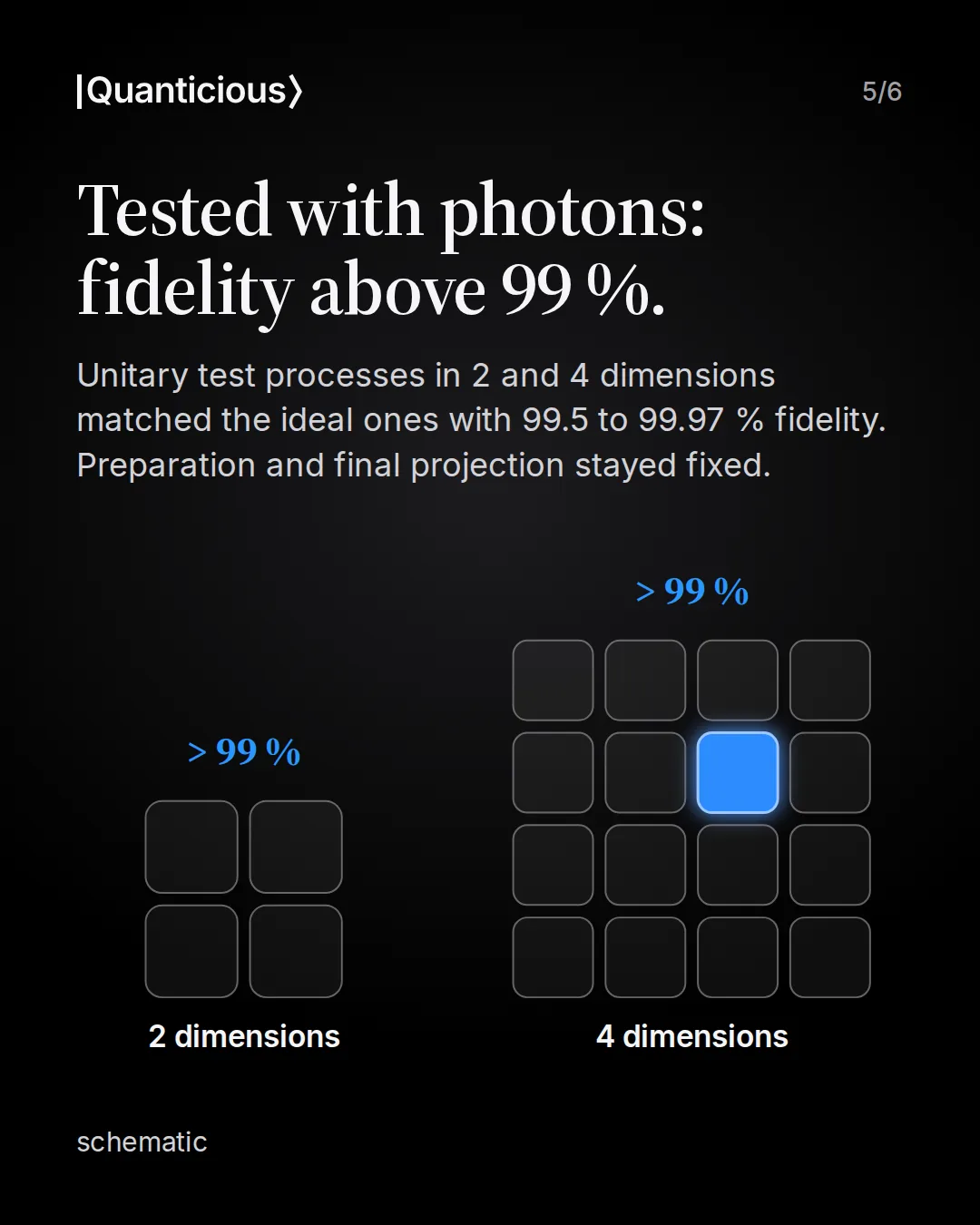

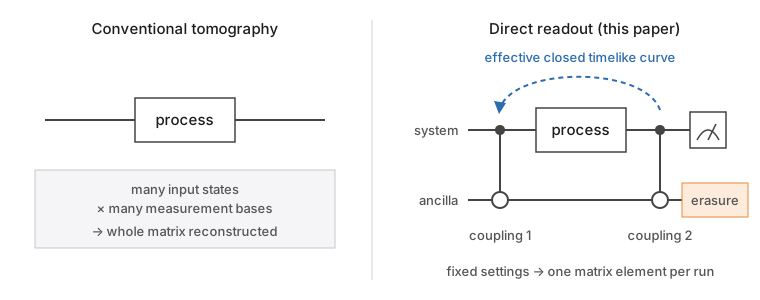
To find out what a quantum device does, physicists usually run many measurements and then put the answer together like a puzzle. This team reads each piece of the answer directly. A helper, here a second property of the same particle of light, is linked to the system before and after the device acts, and then its record is wiped. The wiping works only in some runs, and only those runs are kept. In the mathematics this works like a loop in time, but the authors stress that nothing travels back in time. With particles of light, the results agreed with the ideal devices to better than 99 % on small examples.
A few papers like this every Monday, free.
Free. Unsubscribe anytime. Privacy
The details
Key number: Fidelity from 99.54 % ± 0.07 % (path-CNOT) to 99.97 % ± 0.02 % (identity) for three four-dimensional unitary photonic processes, 49 settings each, using prior knowledge of unitarity
What they did
To find out what a quantum device does to a quantum state, physicists usually run many measurements and then reconstruct a large table of numbers, the process matrix, indirectly. The authors read each entry of that table directly. They couple the system to a helper system (an ancilla) before and after the process and then erase the ancilla’s record with a projective measurement. The erasure succeeds only in part of the runs (one in two or one in three in their scheme), so the method works by postselection. In the pseudo-density-matrix framework they use, this sequence acts as an effective “erasure-based closed timelike curve”, the mathematical analogue of a loop in time. The authors state that this describes an effective interaction in an experiment that respects the normal order of time, not a physical closed timelike curve. The superposition preparation and the final projection stay fixed from one setting to the next, so the measurement basis does not have to be rotated between settings. With single photons they tested the simplified version for unitary processes, two wave-plate operations in two dimensions and three gates in four dimensions. The fidelities ranged from 99.54 % ± 0.07 % to 99.97 % ± 0.02 %.
Why it matters
When the computational-basis states of a system are easy to address, fixed settings can simplify the control needed to characterise it, which gets harder as the dimension grows.
What is still open
The authors say that the number of measurement settings is not reduced for general processes. In which real systems does the simpler control outweigh that, and how does the method behave as the dimension grows beyond four?
The authors note: “For general processes, our protocol does not reduce the configuration count.” (Sec. II, Theoretical framework)