An energy gap that keeps many-level spins squeezed together
Preprint, not yet peer-reviewed | Theory
It gives an analytic mechanism, backed by many-body simulations, for Heisenberg-limited squeezing with the finite-range interactions that molecule, magnetic-atom and Rydberg arrays actually have.
Our understanding
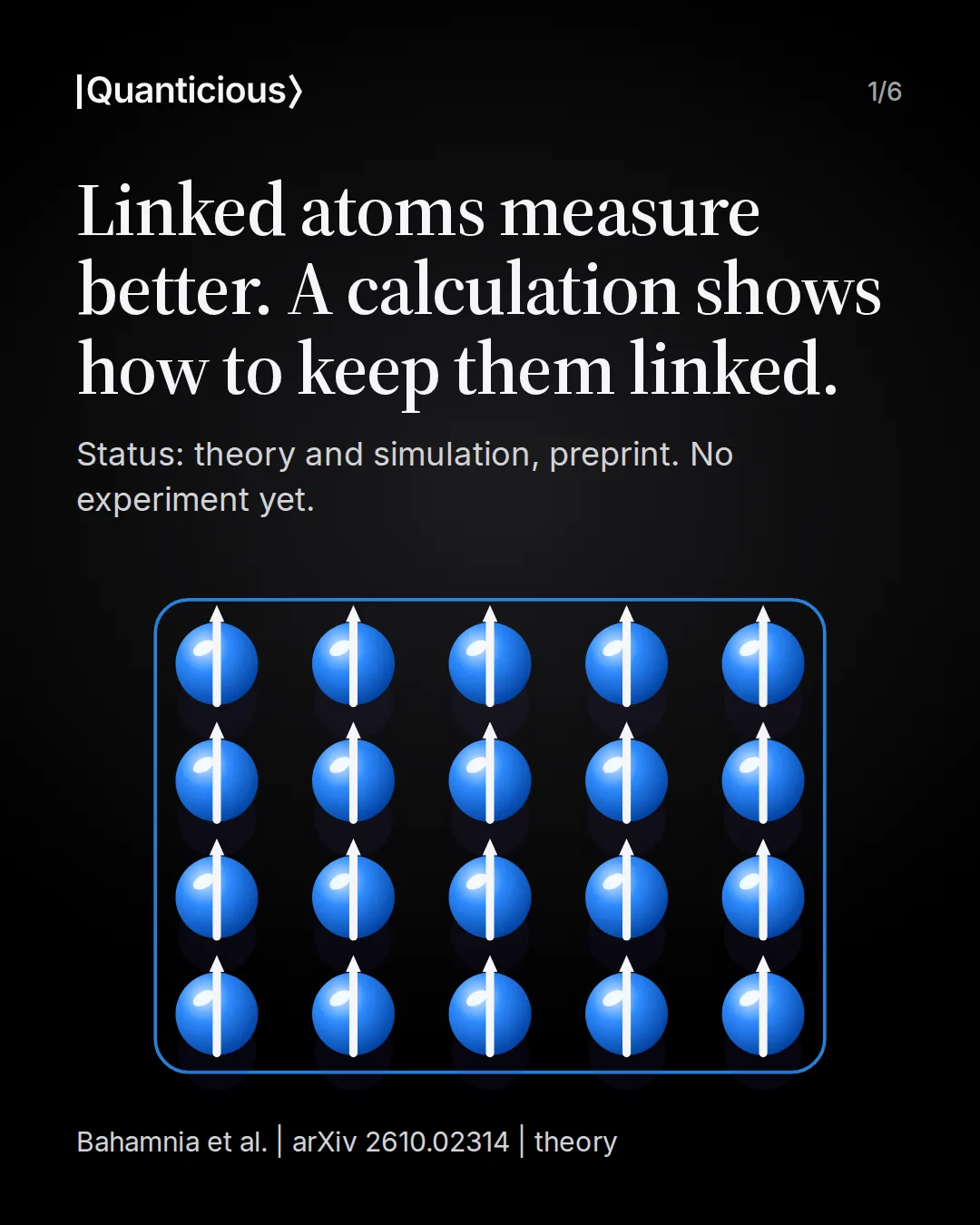
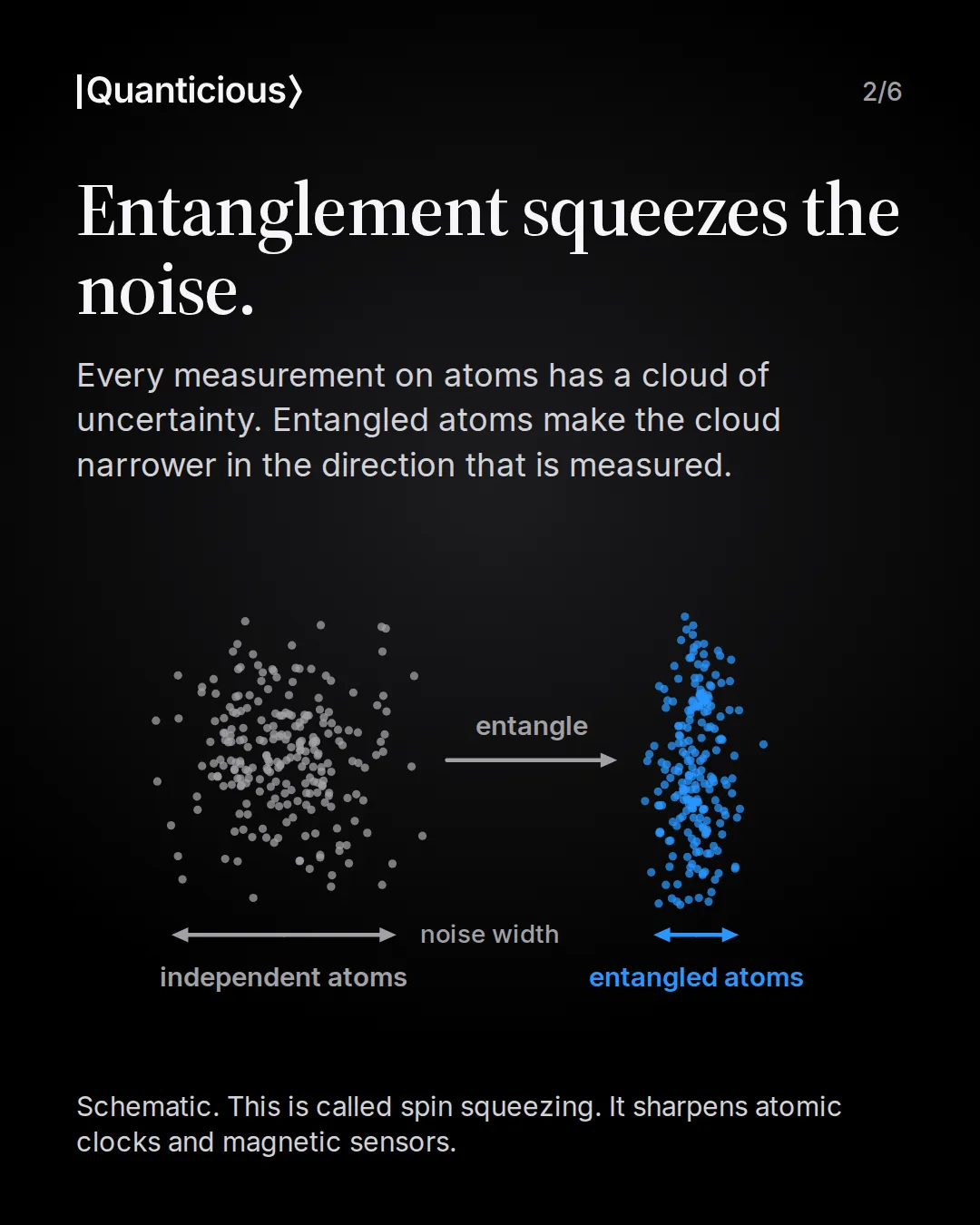
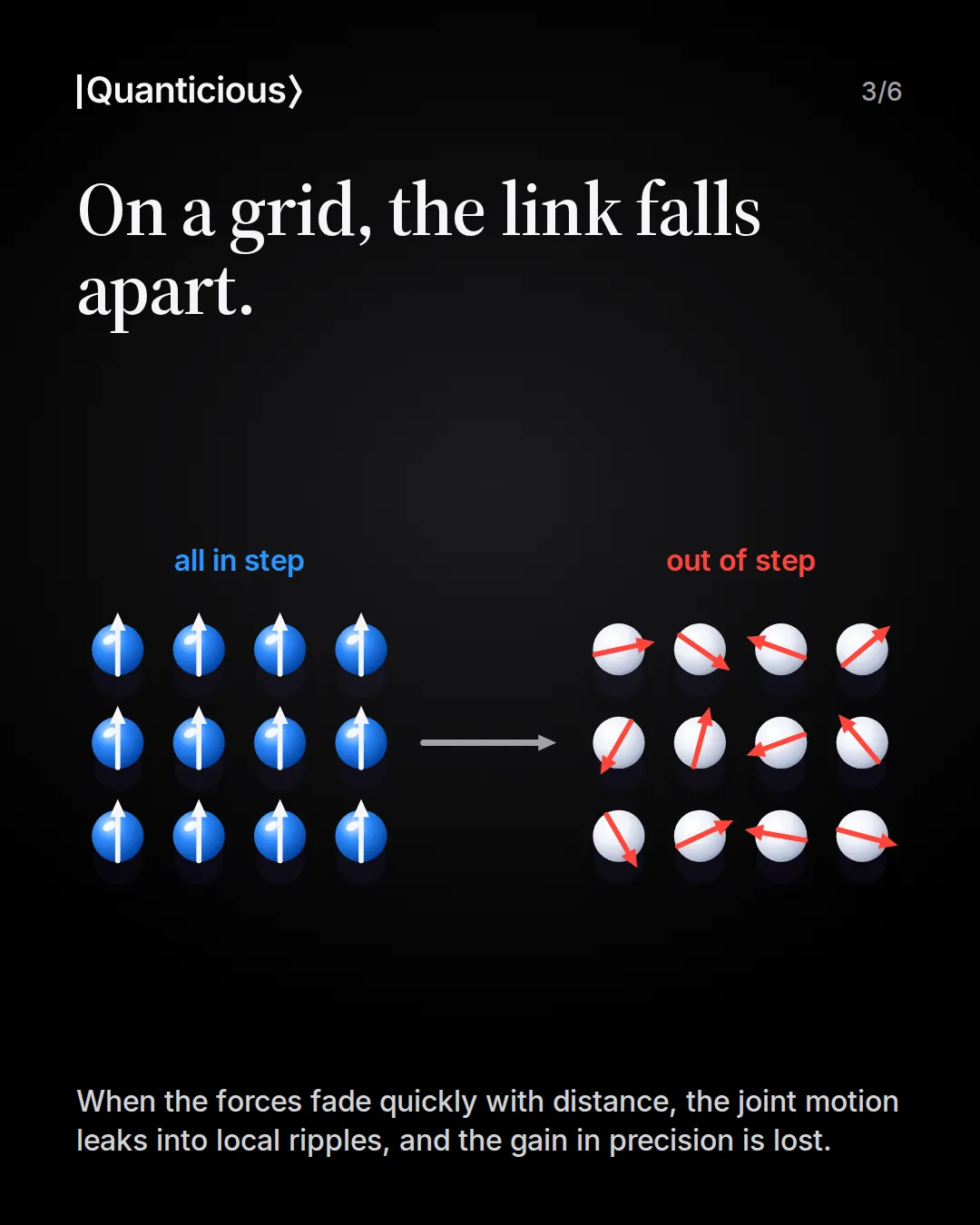
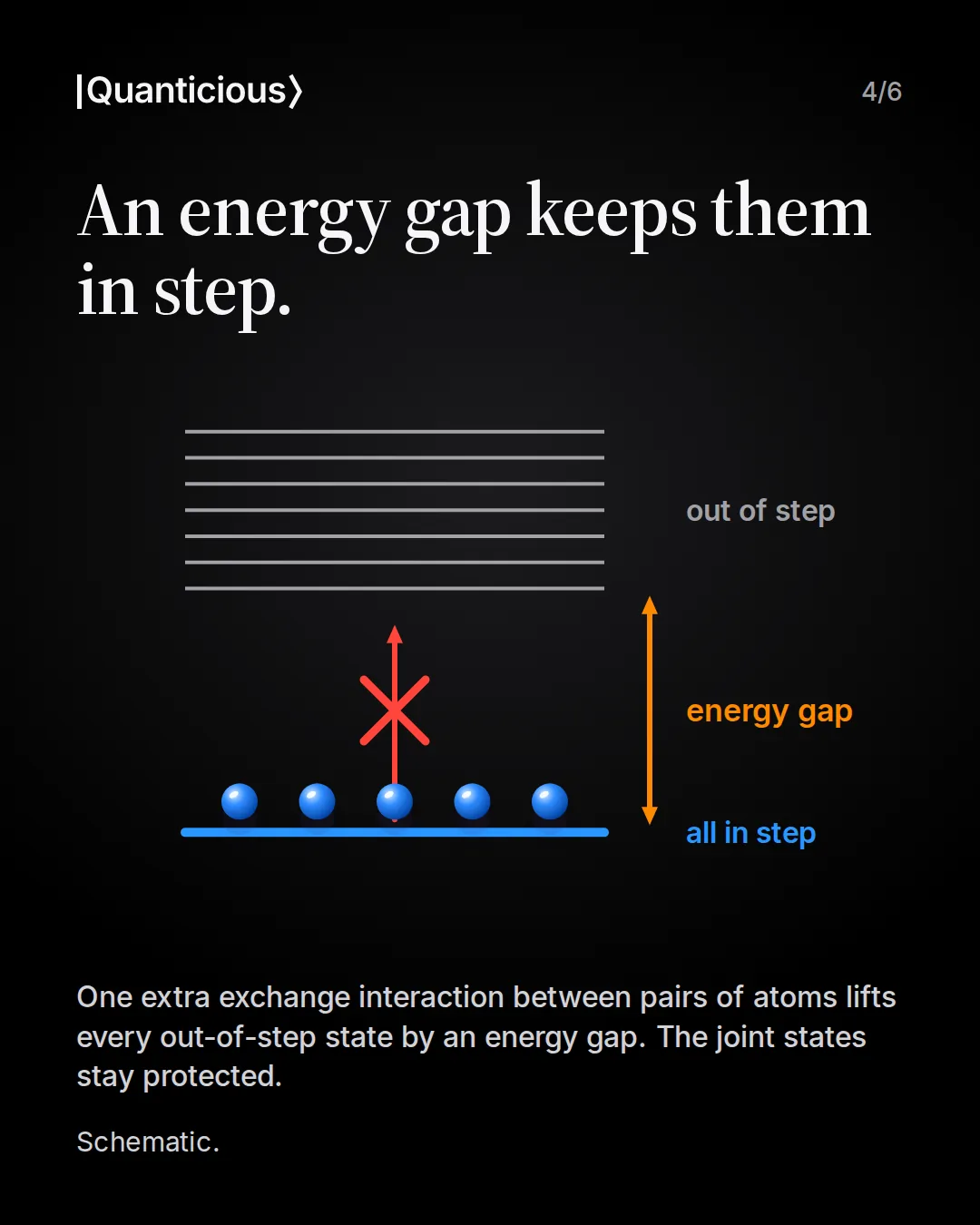
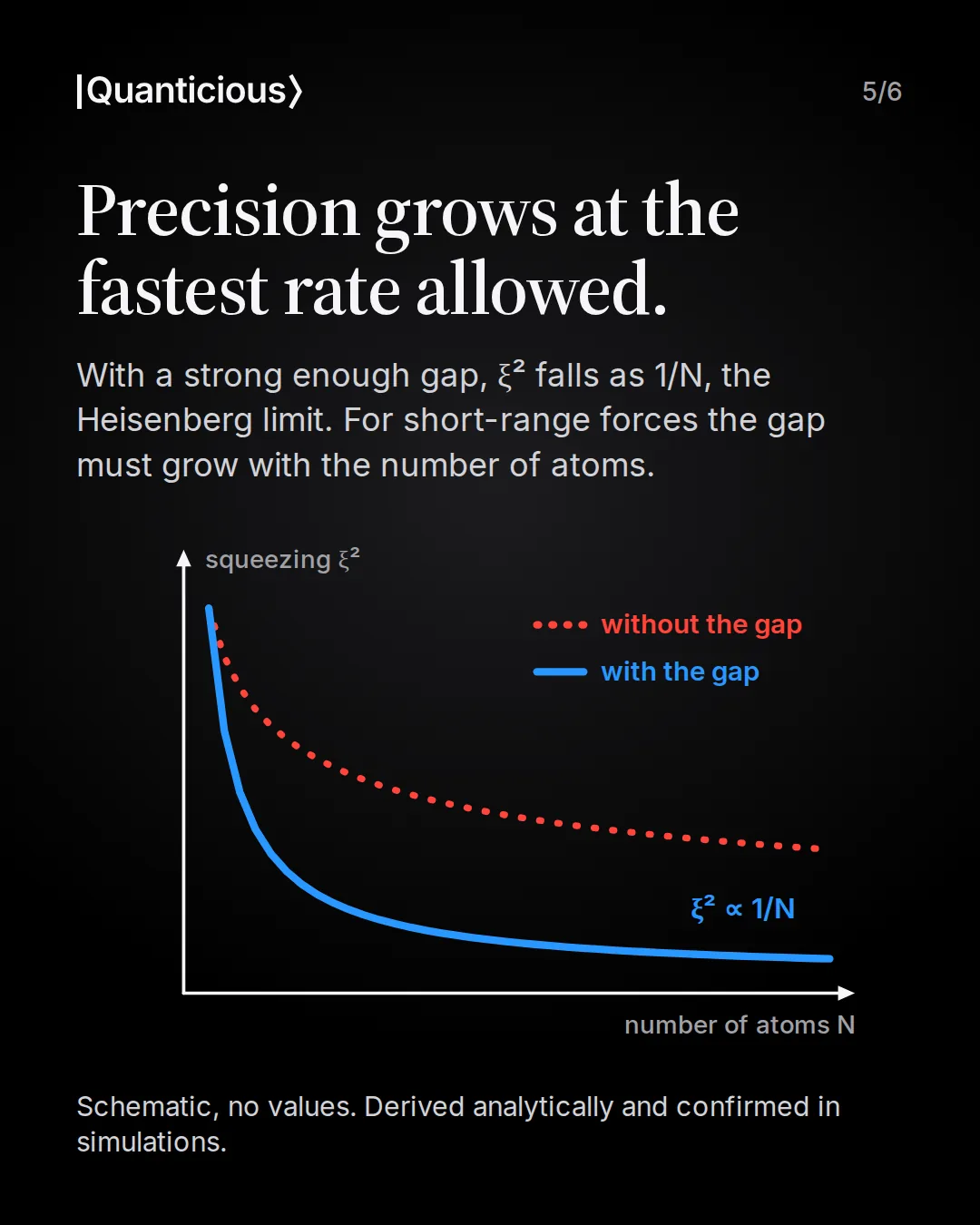

Atomic clocks and magnetic sensors become more precise when their atoms are linked so that they act as one. With many atoms on a grid, this linking usually falls apart when each atom mostly feels its close neighbours. The authors show that one extra interaction between pairs of atoms creates an energy barrier that keeps the atoms in step. If that interaction is strong enough, precision grows at the fastest rate physics allows as more atoms are added. For forces with a short reach it has to get stronger as the grid grows. This is a calculation. Experiments are still to come.
A few papers like this every Monday, free.
Free. Unsubscribe anytime. Privacy
The details
Key number: Heisenberg scaling ξ² ∝ 1/N restored above χ/χc ≈ 1.25 in 1D and 2D and ≈ 1.45 in 3D in simulations, where χc grows with system size when the power-law exponent exceeds the dimension
What they did
Spin squeezing entangles many spins so that a measurement, for example in an atomic clock or magnetometer, becomes more precise than with independent particles. The best possible scaling with particle number N is the Heisenberg limit. The authors study three-level spins (spin 1) that interact through power-law forces on a lattice, a setting that describes polar molecules, magnetic atoms and Rydberg atoms. A pair process turns two particles in the middle level into one in the upper and one in the lower level. Without all-to-all interactions this dynamics leaks into non-collective modes, and for forces that fall off quickly with distance the Heisenberg scaling is lost. The authors add an su(3) exchange interaction between pairs of particles, with the same distance dependence as the native interaction. It opens an energy gap that protects the collective states and restores Heisenberg scaling, ξ² ∝ 1/N, in one to three dimensions for any power-law exponent, provided the exchange is strong enough. When the power-law exponent exceeds the dimension, the required strength grows with system size. For dipolar forces it grows as ln L in 3D, as L in 2D and as L²/ln L in 1D, where L is the linear size of the lattice. The mechanism is derived from a Bogoliubov analysis and confirmed with approximate (truncated Wigner) simulations. The authors state that it carries over to more internal levels via su(D).
Why it matters
It gives a general recipe for metrologically useful entanglement in lattice platforms, extending spin-nematic squeezing from spinor Bose-Einstein condensates to spatially extended systems. The paper also shows that the protection keeps the squeezing robust when some lattice sites are empty. This is theory and simulation in a preprint.
What is still open
The paper sketches a realisation with polar molecules, where a static electric field of about 2 to 13 kV/cm makes the pair process resonant and microwave pulse sequences engineer the protecting interaction. Whether this works in a lab, and how much squeezing survives particle loss and dephasing during the dynamics, is open (our inference).
The authors note: “for α>d, χ must grow with L” (Bogoliubov theory)