When warming some superconductors makes them stronger
Peer-reviewed in Physical Review Research | Theory
It predicts a counter-intuitive and testable effect in known two-band superconductors and gives field scales an experiment can aim for.
Our understanding
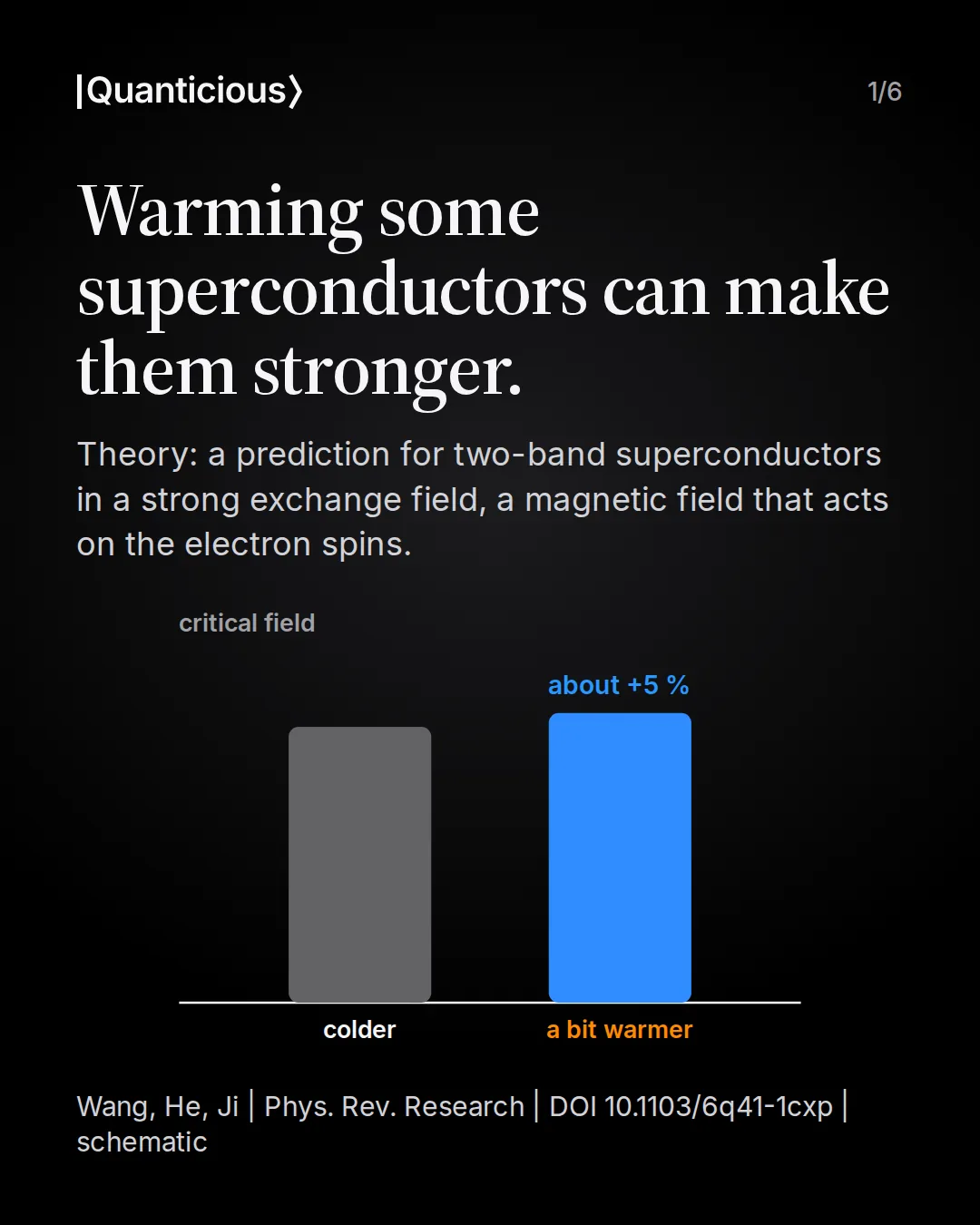
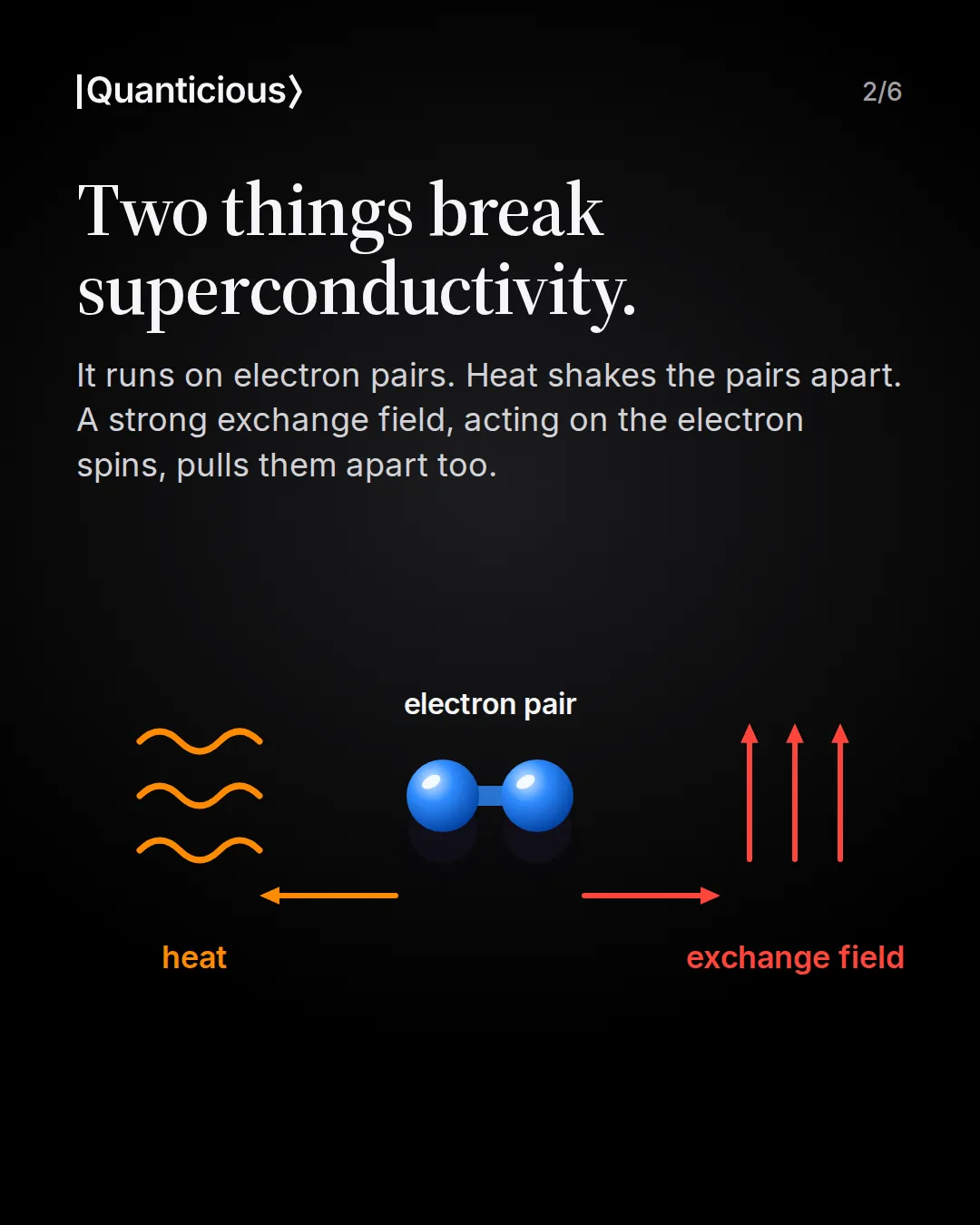
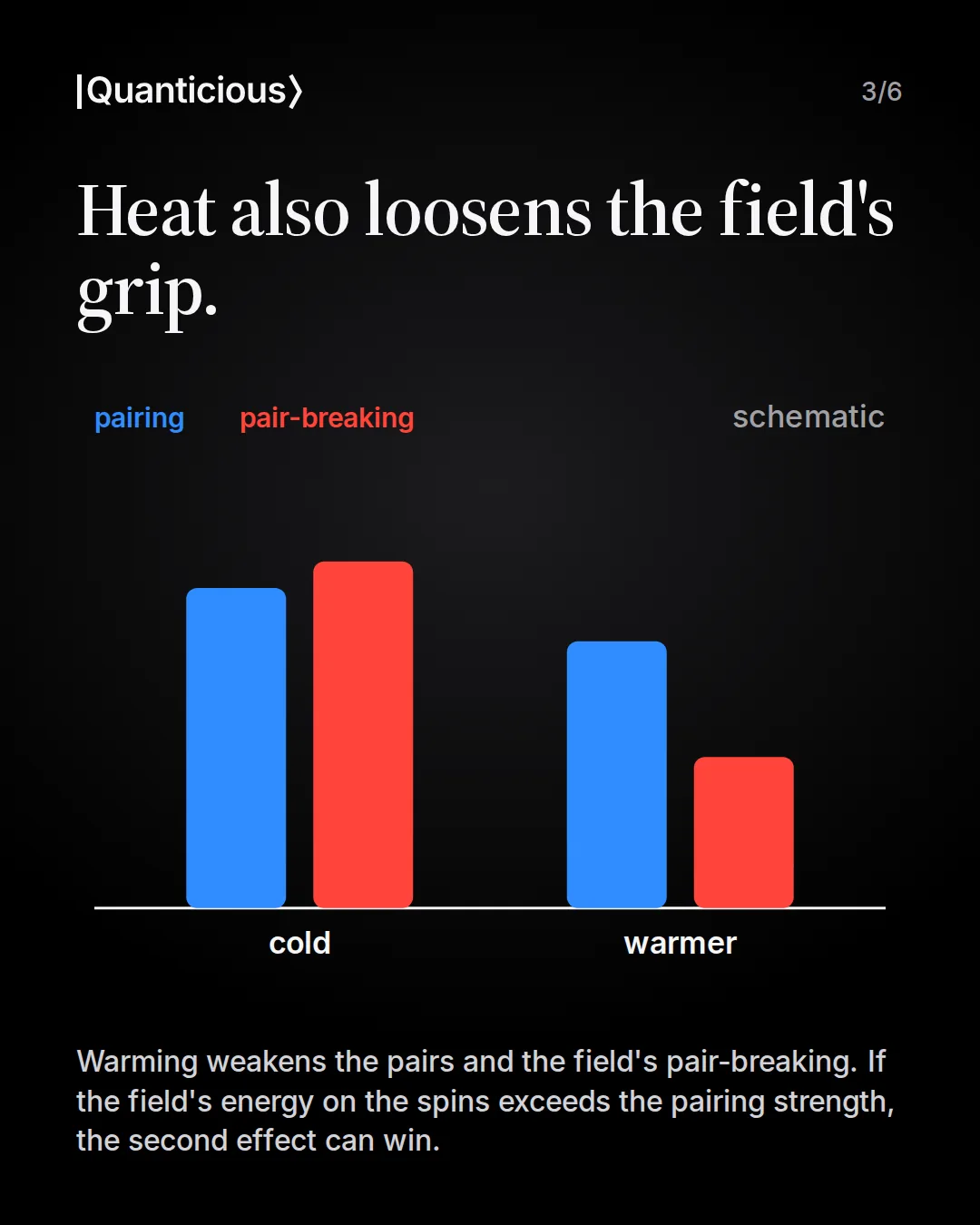
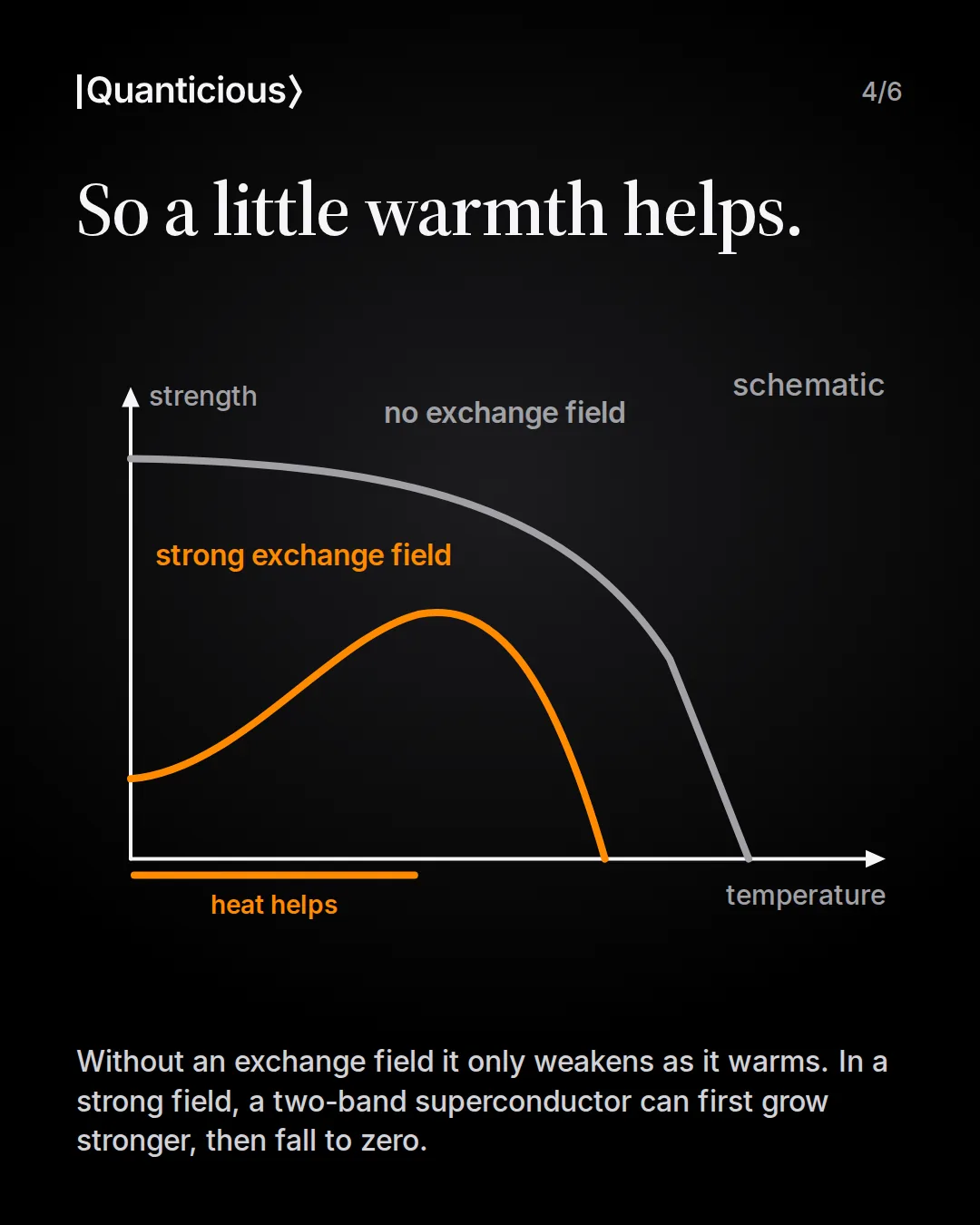
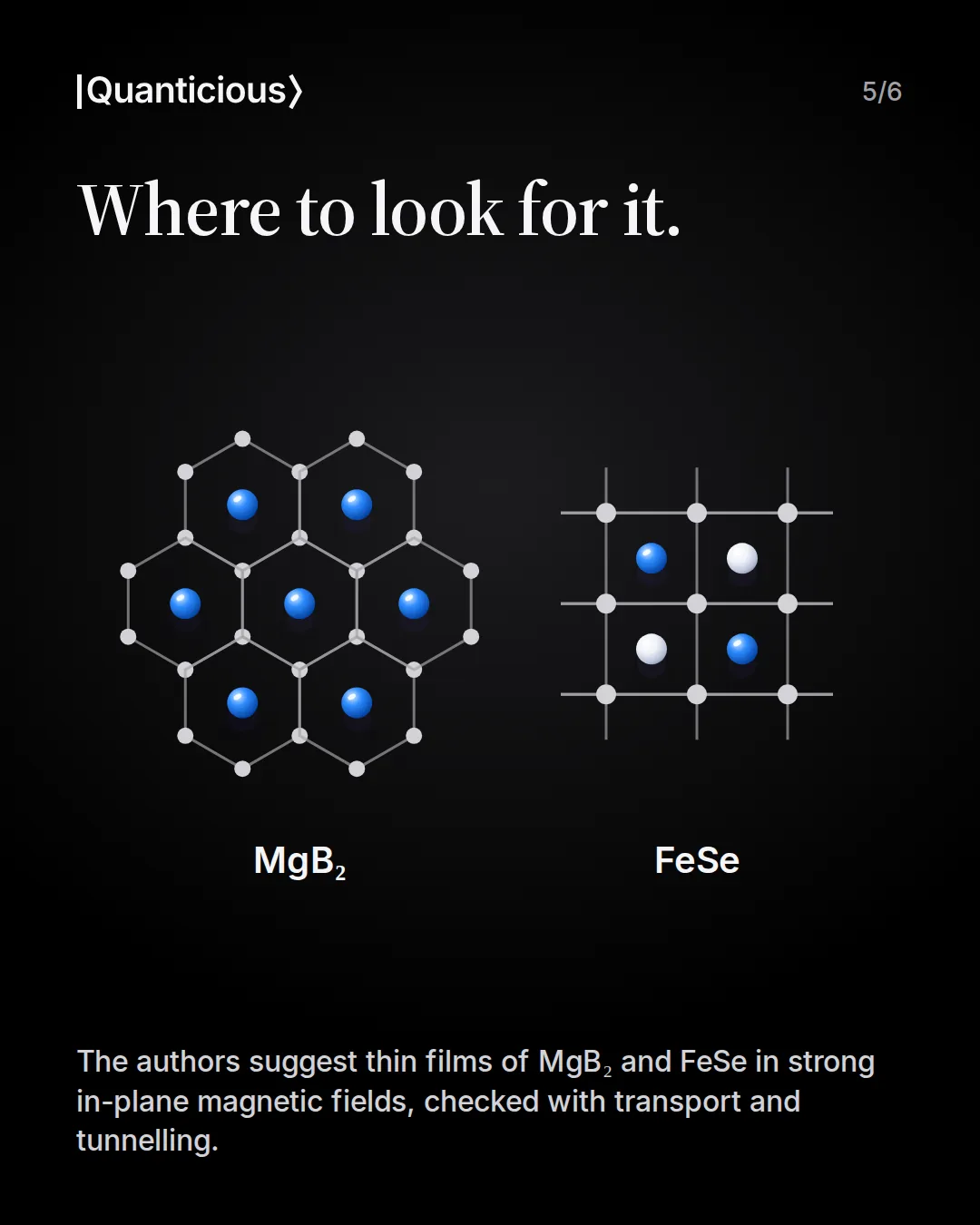
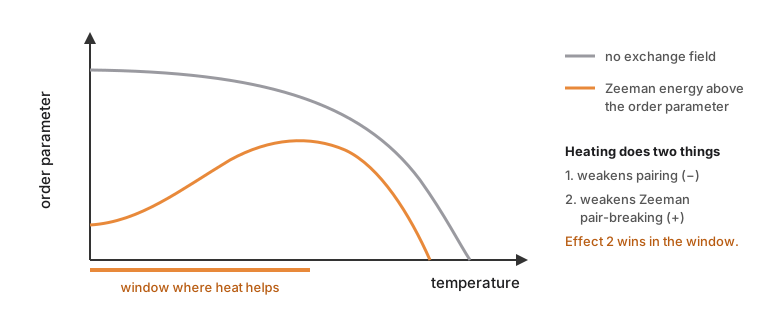
Superconductors carry electricity without any loss, and heat normally destroys this. A strong magnetic field destroys it too, by breaking up the electron pairs that carry the current. The authors calculate that in some superconductors with two groups of electrons, under such a strong field, warming weakens the pair-breaking more than the pairs themselves. Then a little heat makes the superconductor slightly stronger, by about 5 % in the field it can withstand. In the simplest superconductors this does not happen. They name MgB₂ and FeSe as test materials. It is a prediction, not yet a measurement.
A few papers like this every Monday, free.
Free. Unsubscribe anytime. Privacy
The details
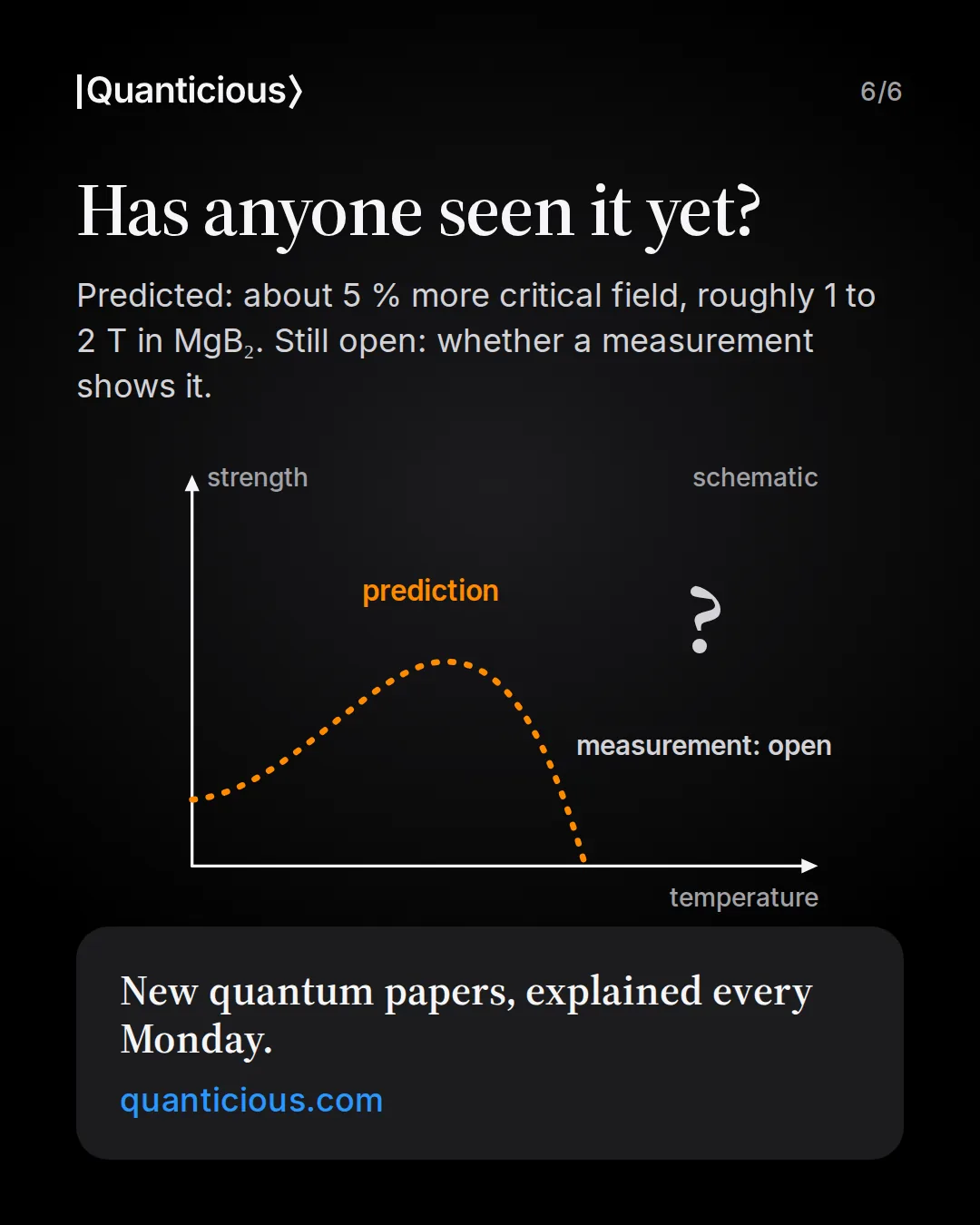
Key number: Critical field raised by approximately 5 % at a small finite temperature (authors' estimate, no error bar), on the order of 1 to 2 T in MgB₂, in the limit of strongly coupled bands
What they did
Heat normally destroys superconductivity. A strong exchange field, a magnetic field that acts on the electron spins, also destroys it, by pulling apart the electron pairs that carry the supercurrent (the Zeeman effect). The authors analysed the free energy of thin superconducting films in a large in-plane magnetic field, which acts purely as an exchange field. They find that temperature does two things at once. It weakens the pairing through thermal excitations, and it also weakens the field’s pair-breaking. When the Zeeman energy is larger than the superconducting order parameter, the second effect can win, so warming makes the material more superconducting over a temperature window. In the simplest one-band s-wave case this does not happen, because the order parameter stays at full size and then drops abruptly to zero. In a two-band model it does happen, and a clear rise of the critical field appears only in a window of parameters where the two bands are suitably balanced. For MgB₂ and FeSe the authors estimate a rise of the critical field of about 5 % in the limit of strongly coupled bands, roughly 1 to 2 T in MgB₂ and a few tenths of a tesla in FeSe, measurable by transport and tunnelling on thin films.
Why it matters
It identifies a thermodynamic mechanism for a counter-intuitive effect and gives field scales that experiments can check. The authors note that earlier calculations showed a slight enhancement without singling it out. Large exchange fields can also arise when a thin superconductor sits next to a magnetic material (our inference).
What is still open
Will measurements on MgB₂ or FeSe films in strong in-plane fields show the predicted rise of about 5 % in the critical field, and how much smaller is it when the two bands are less tightly coupled?
The authors note: “although its quantitative magnitude decreases as the interband locking is weakened” (Sec. V, Summary and discussion)